Menu Close

escapade sailing

life on the ocean

Galápagos

DSC_9449

Isla Santa Cruz

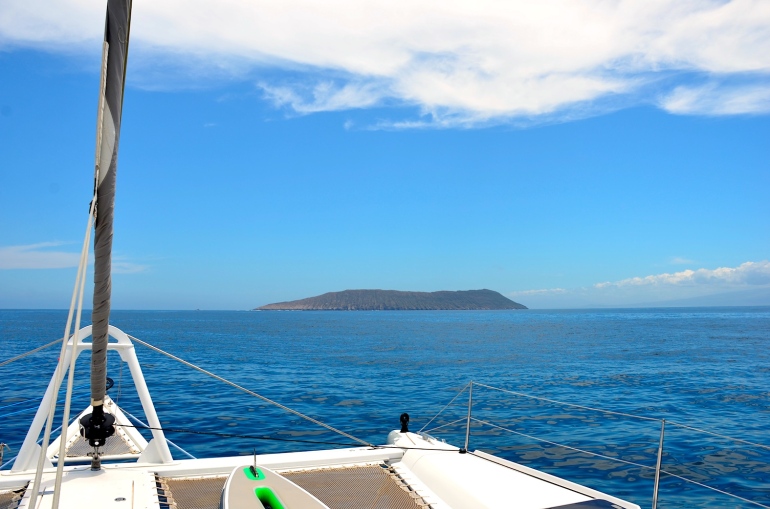
Having dragged Jemima away from the sea lions of San Cristobal, we sailed to Santa Cruz.  The doldrums continue to produce glassy calm seas for us, sailing weather best suited to diesel engines.  I am so looking forward to the trade winds further south.

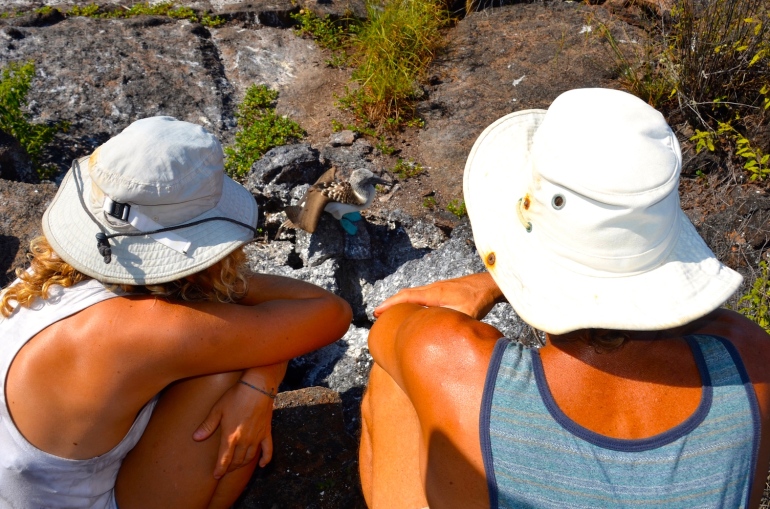
Santa Cruz is the centre of tourist tripping in the islands.  A pleasant little place with plenty of cafes, wifi, t-shirts and the Charles Darwin Research Institute.  It is populated by laid back local Ecuadorians and roaming gangs of sun burnt eco-tourists dressed in wide brimmed hats and beige safari suits, being led by a National Park guide.

One spin-off of this tourism is the recent arrival of some great restaurants, we ate well.  They are growing quite a few crops on Santa Cruz, so rather than the usual fried snapper with plantains, we are offered ‘farm to table’ modern Ecuadorian fine dining no less!

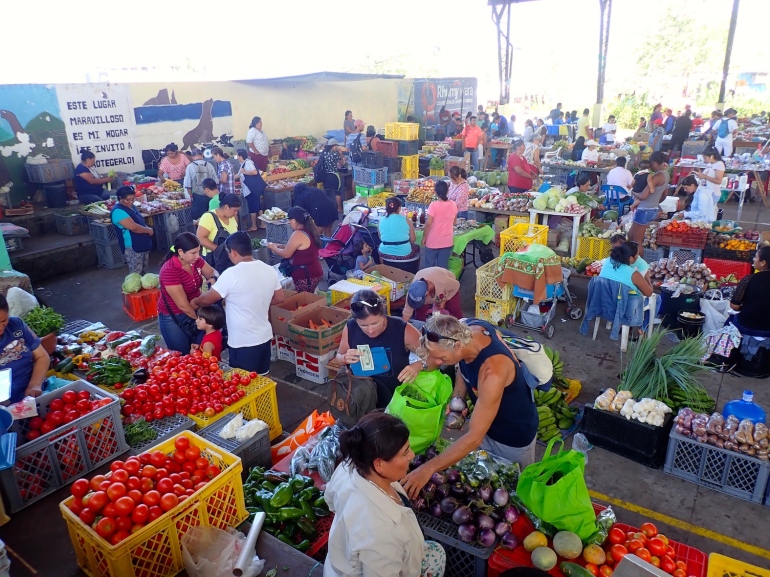
There is also a great Saturday morning farmers market to top up our stores, a huge open barn full of fresh produce, followed by a trip to the breakfast stand where they fry up a very sustaining plateful for the early morning marketeers.

OLYMPUS DIGITAL CAMERA

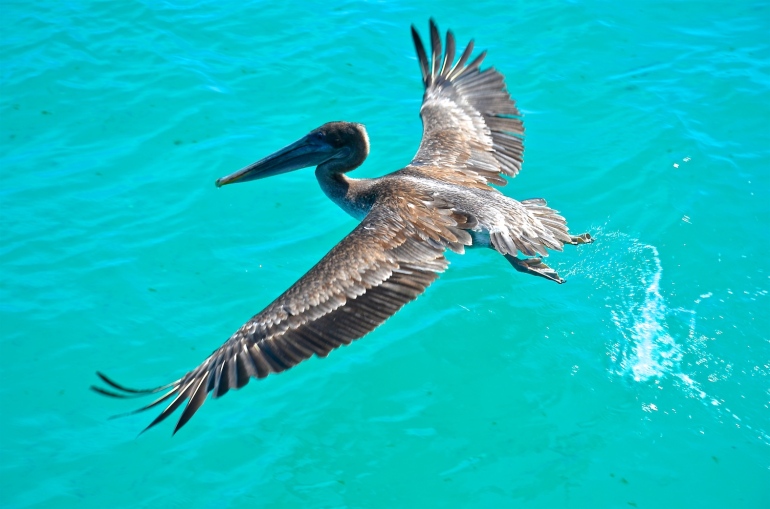
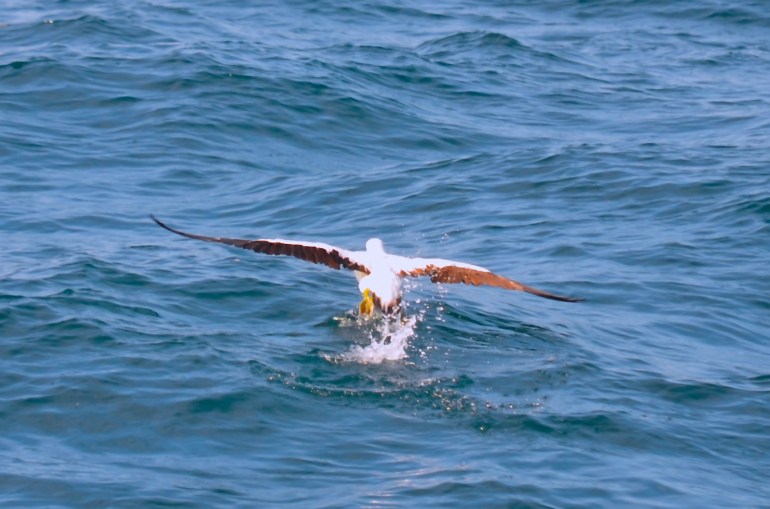
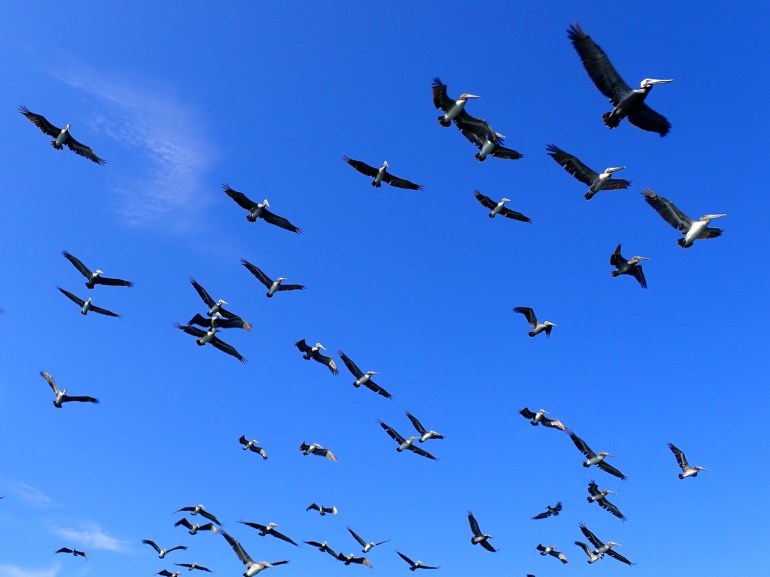
There are lots of young black-tip sharks swimming around the boat, large eagle rays, the usual boobies and pelicans dive-bombing.  On land there are plenty of iguanas and another breeding centre for giant tortoises.

DSC_9458

There is nature to see here, but most of it has been packaged up to sell as a tourist day trip, which I have an irrational aversion to.

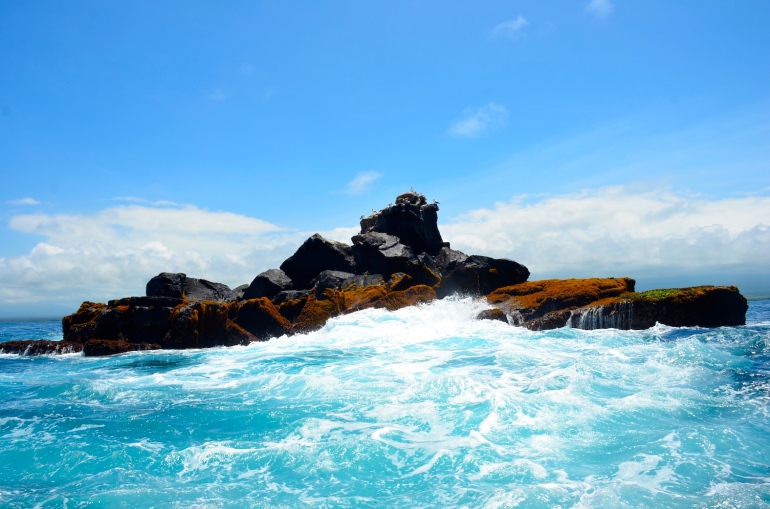
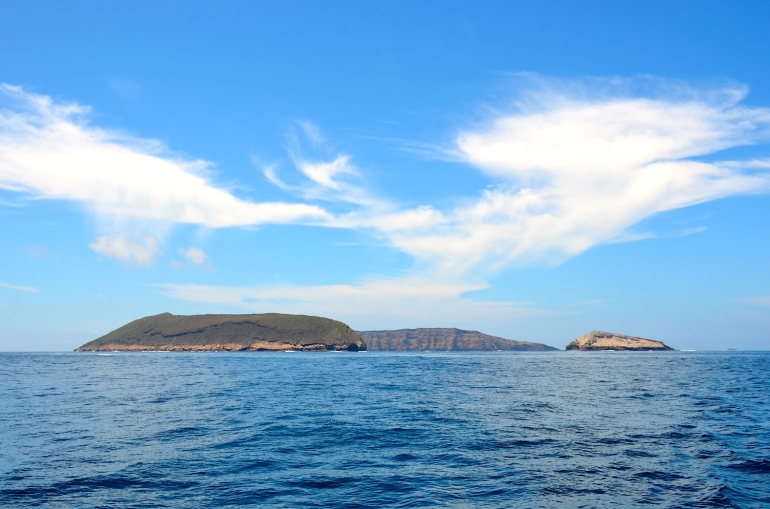
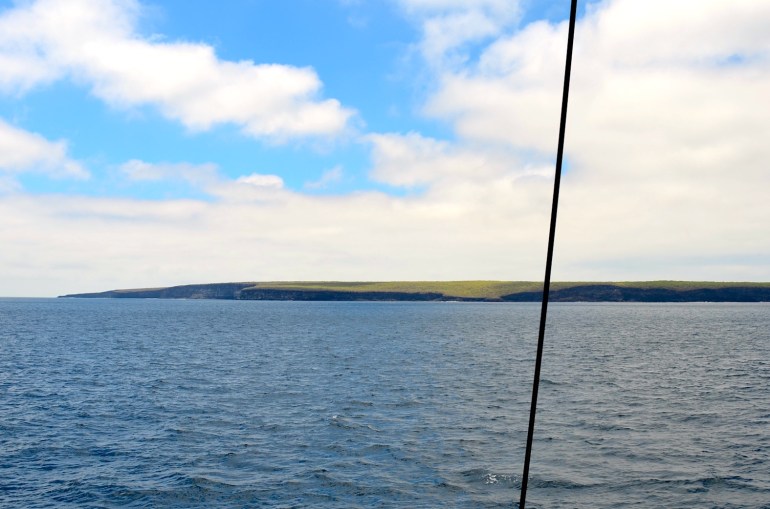
We head for the next stop, Isla Isabella.  Past the spectacular Isla Tortuga, a jagged crater rim emerging from the sea, swell surging around its rocky walls.

DSC_9258DSC_9287

Isla Isabella 

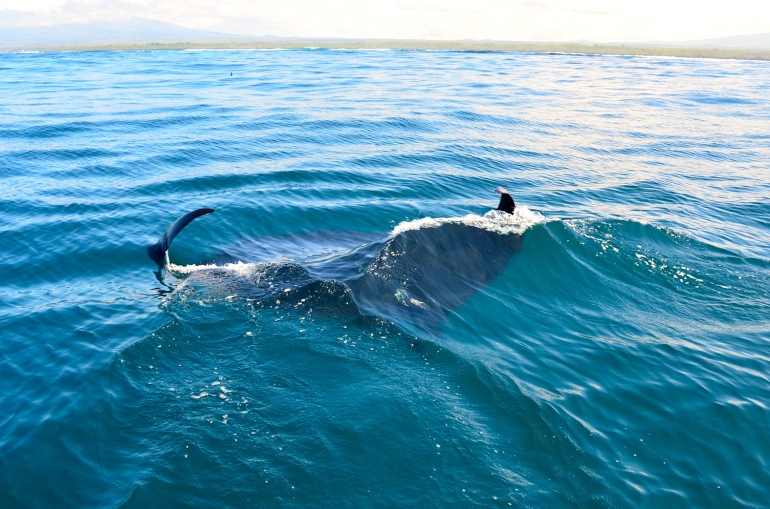
A large hammerhead appeared to welcome us to Puerto Villamil, a lovely shallow lagoon to anchor in.

This feels like a real sleepy backwater in comparison to Santa Cruz.  Sea lions playing in the mangroves around the shore, sandy dirt roads in the village.

OLYMPUS DIGITAL CAMERA

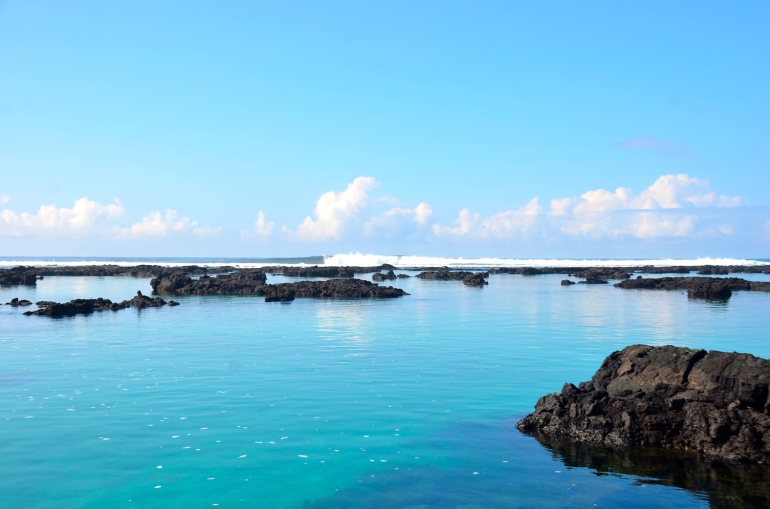
More surf, not the powerful point breaks of Cristobal, but a very fun beach break a few minutes away, I have surfed it every day.  Lots of waves here. I remember watching Sir David Attenborough’s programs from the Galapagos years ago and being distracted by the waves peeling behind Sir Dave.

DSC_9313

Los Tuneles

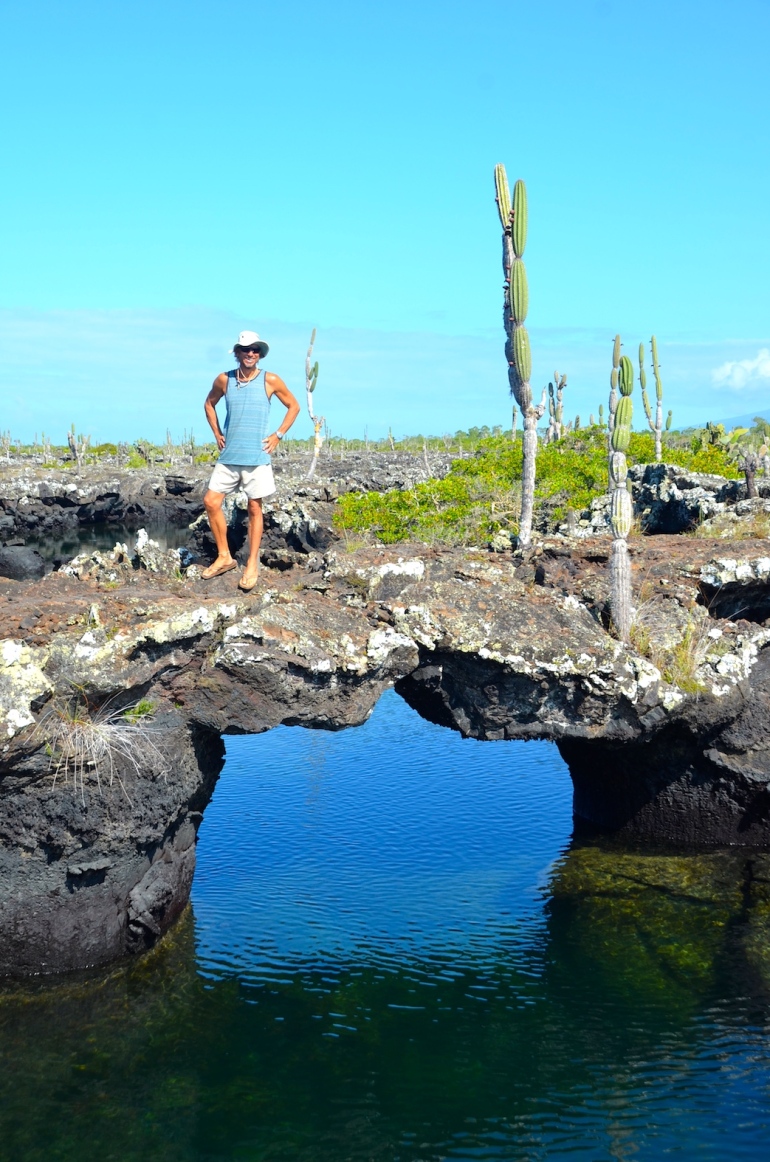
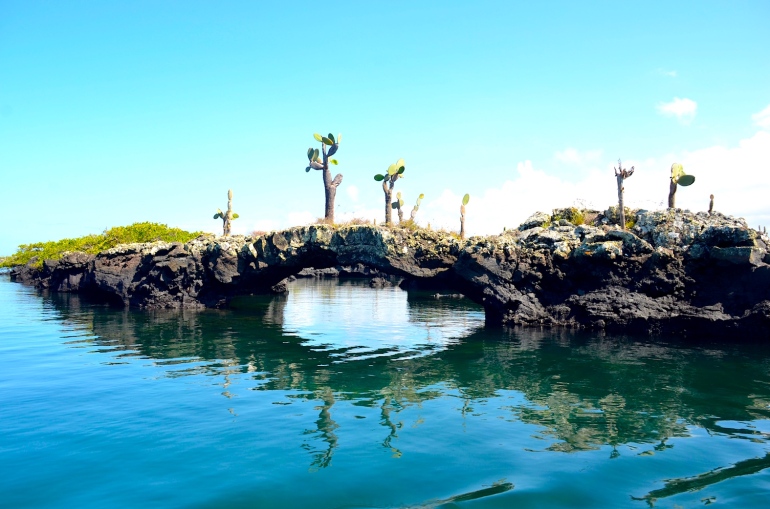
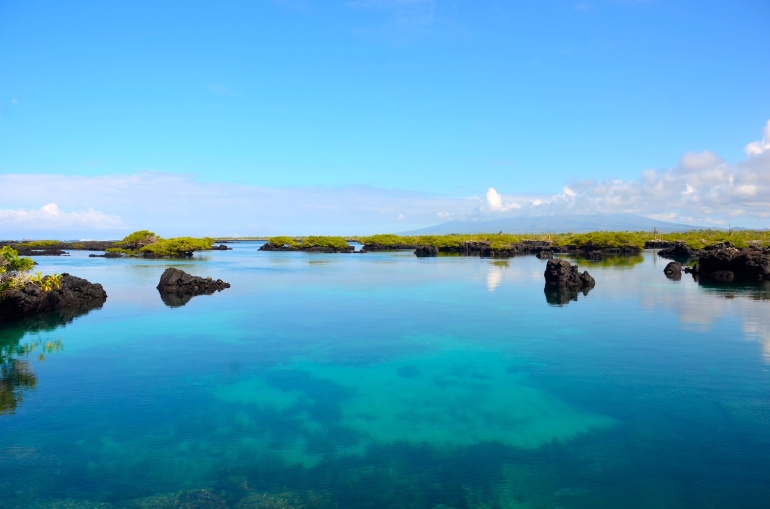
This is really a one-off landscape, unique to the Galapagos.  The only way to see it of course is to sign up for a boat trip with a local naturalist as your guide. (I am trying.)

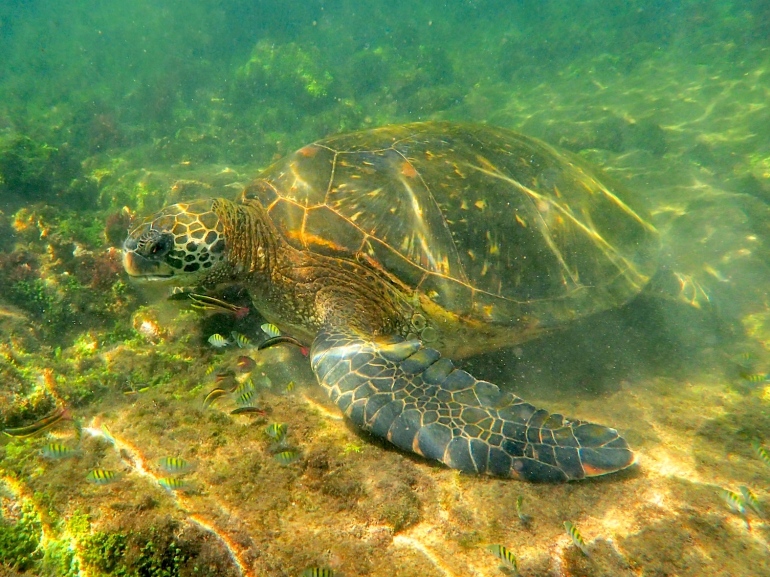
It’s a remote area of mainly collapsed ancient black lava tubes, leaving arches and bridges standing in a labyrinth of clear aquamarine pools, channels and caves.  Sea-lions chasing the boat.  Tidal waters full of life, we snorkelled with sleepy white-tipped sharks and huge grazing sea-turtles.   Above the water are mangroves and candelabra cacti hundreds of years old.  Outside the reef we saw giant manta rays.  The whole trip was pretty amazing.  Sometimes you just have to be the tourist.

DSC_9334DSC_9321OLYMPUS DIGITAL CAMERADSC_9380DSC_9319

Dancing Boobies

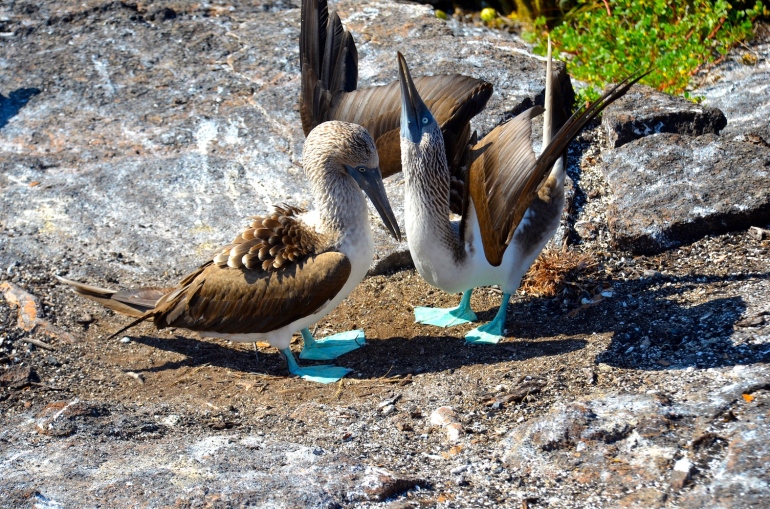
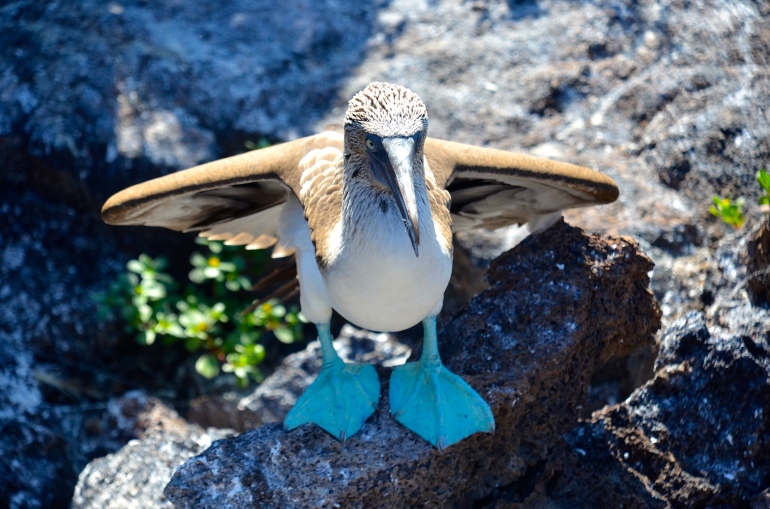
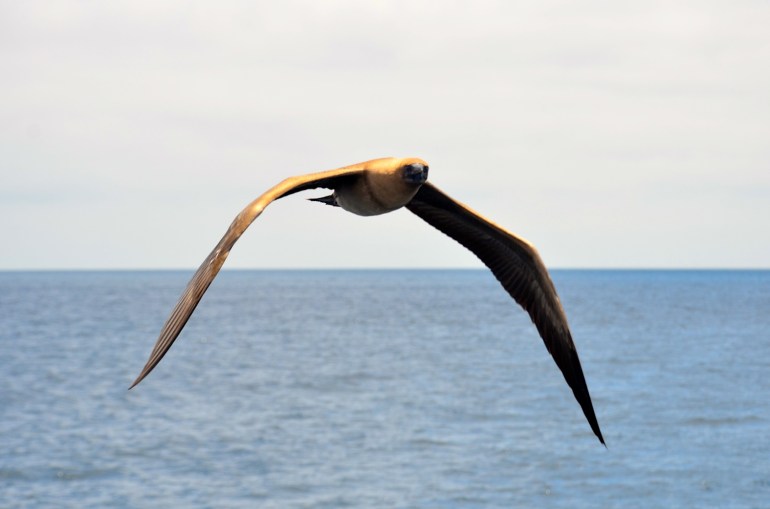
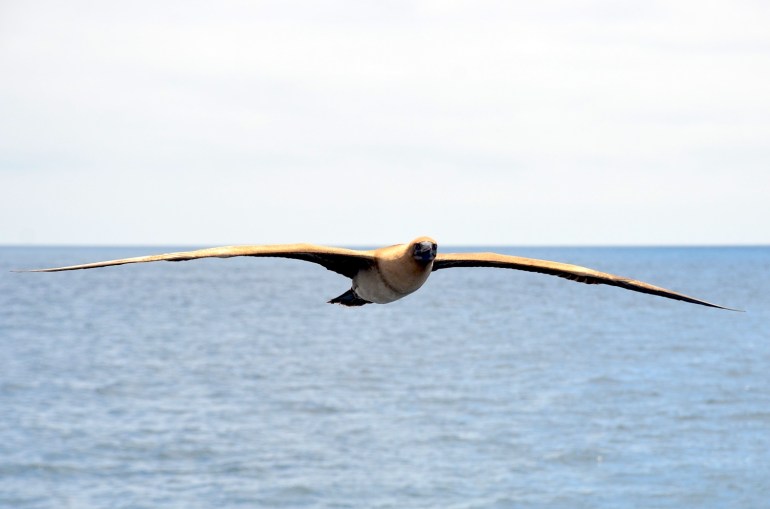
I have read about the ‘complex and comical’ courtship dance of the Blue Footed Booby.  In flight, boobies look much like a Guernsey Gannet in shape: streamlined fuselage, feet tucked away, low level gliding and a powerful dive from a great height.  We have seen a few of these birds around the islands but not up close, and certainly not dancing.  In Los Tuneles we almost tripped over a pair, mid performance.  It’s wonderful.  Slo-mo foot raises, whistling (male), grunting (female), all sorts of posturing.  Apparently the male needs to persist with this dance for WEEKS before the female acquiesces.

DSC_9350DSC_9369DSC_9371

We have noticed that several birds, animals and fish here are not afraid of us, or camera shy, but seem to be positively performing and posing for their close up!

The Booby dance is on the video, if you make it past the sea-lion footage..

DSC_9392

Penguins

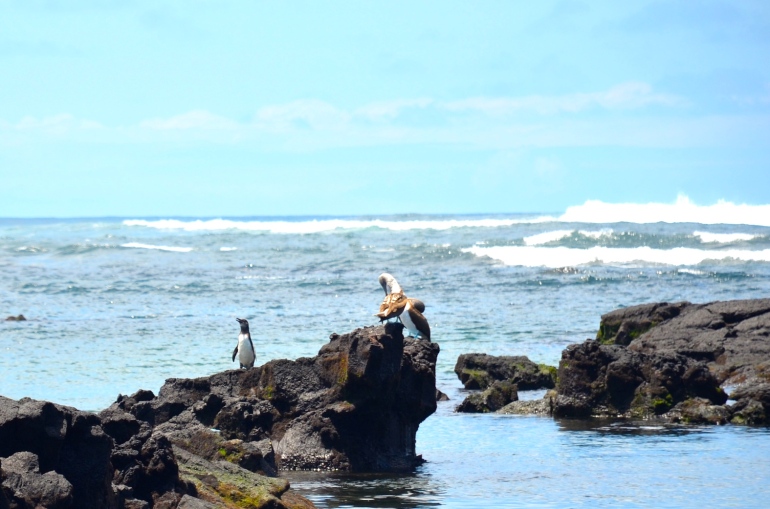
This special Galapagos penguin is only to be found here.  Penguins!  On the Equator!  They are often seen in the bay where we are anchored, but it’s still too warm here, they are enjoying colder currents in the western islands.  So I had given up on seeing penguins here, but just as we were swimming back to our trip boat, the skipper called out “Pinguino!”  And there he was, a solitary penguin waddling along a rock next to another pair of dancing boobies.  Only in Galapagos!  I may buy a safari suit.

DSC_9432

Now what?

Dawn is flying home to the delights of springtime in Guernsey, catching up with family and friends.

Jemima and I are planning to sail the next part of the Pacific and meet Dawn again in Polynesia in a few weeks.

OLYMPUS DIGITAL CAMERA

Hare brained scheme

The traditional route from here is to sail to the Marquesas, the closest, northernmost islands in French Polynesia.

It is a well-trodden path these days.  This is the start of the cyclone-free season in Polynesia and most of the boats we met in Panama are making their way to the Marquesas.  I’m told the anchorages get crowded at this time of year.

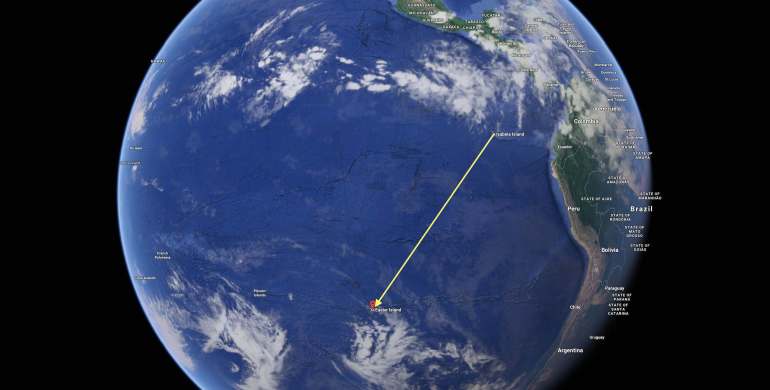
So Jemima and I have decided to sail 2000 miles south instead, along the much less frequented route to Rapa Nui (Easter Island).

Bit of a detour.  If it all works out we’ll enter Polynesia via Pitcairn and the Gambier islands, (another 1200 miles) by which time it will be winter down there.

So thermal underwear possibly, but we will be 900 miles south of the crowd.

OLYMPUS DIGITAL CAMERAOLYMPUS DIGITAL CAMERA

Next Update

Well Dawn won’t be onboard to run the IT department!
We will try to send some text via the sat phone, if not it may be a quiet month on the blog!
Video

So here’s the roundup of footage from the last month, sorry but the sea lions have really stolen the show.  Again.


Isla San Cristobal

OLYMPUS DIGITAL CAMERA

The first thing I become aware of here in the Galapagos is that there are quite a lot of rules restricting my usual behaviour.

We are used to exploring by yacht, dinghy, paddleboard and windsurfers.  Finding deserted anchorages, freediving with the fauna, spearing the odd fish for supper, swimming ashore and generally doing exactly as we please.  Here of course the whole place is rightly protected from the likes of me.  A national park to ensure the future of a globally important natural wonder.  This does mean that if I want to go and see much beyond the three anchorages we are permitted to be in, I have to sign up to a tourist trip and be processed with the herd, which I’m just not good at. But I’m trying.

DSC_8078

The Sea Lions

The first day I went for a swim at the town beach and was joined by a frolicking young sea lion darting around me.  A lifeguard in a tower blew his whistle and said I was too close to the pup.  Well really.  These young sea lions are just ridiculously playful and friendly, more about them later.  First a word about their biggest fan, my daughter Jemima.

She does like a pinniped, her face lights up at the honk of a nearby pup. She spent a summer teaching sailing and hanging out with the sea lions in California, which became the subject of the final dissertation for her marine biology degree.  Then there was an orphan fur seal pup she nursed in South Africa, the Kiwi fur seals she found to play with in the wilds of South Island and most recently some sea lion spotting in the Falkland Islands on a yacht delivery stopover.

So the Galapagos Archipelego could be described as ‘right up her street’.

OLYMPUS DIGITAL CAMERA

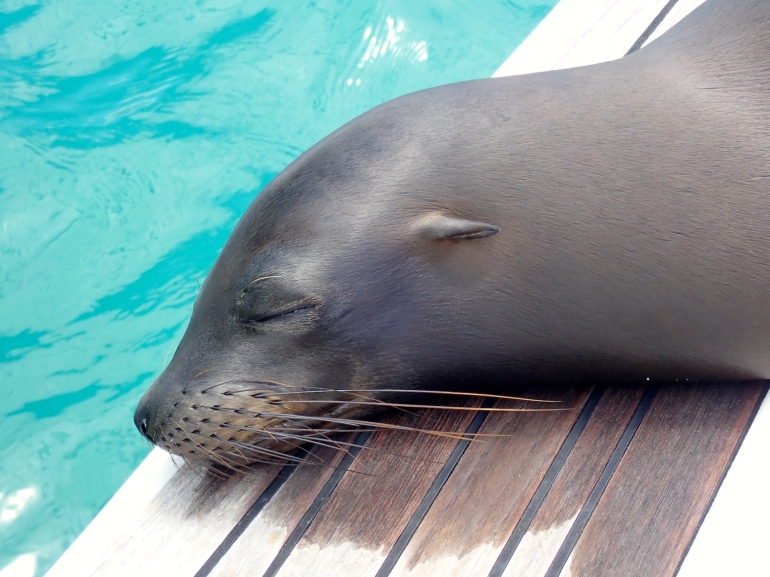
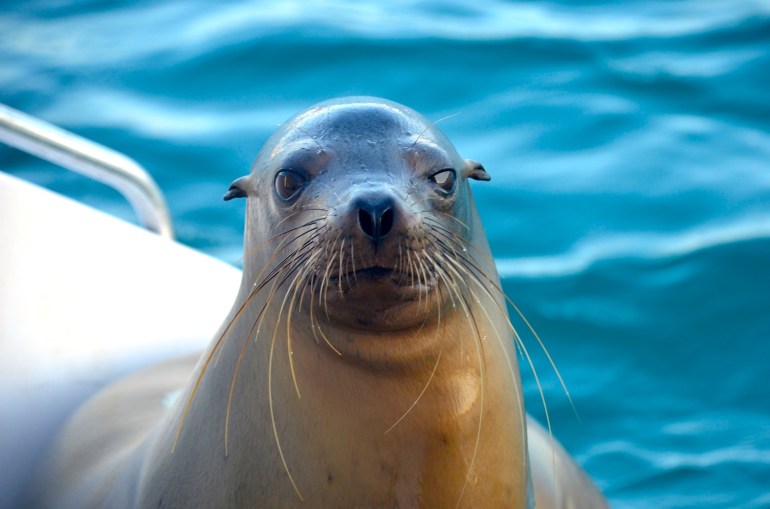
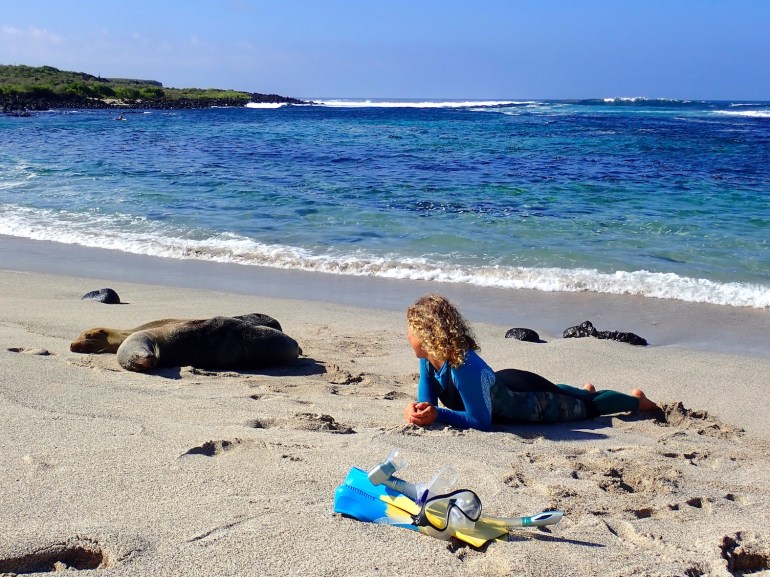
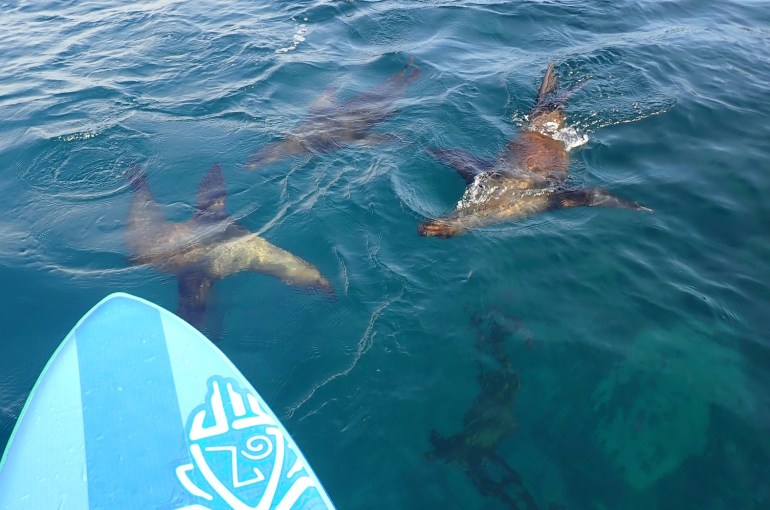
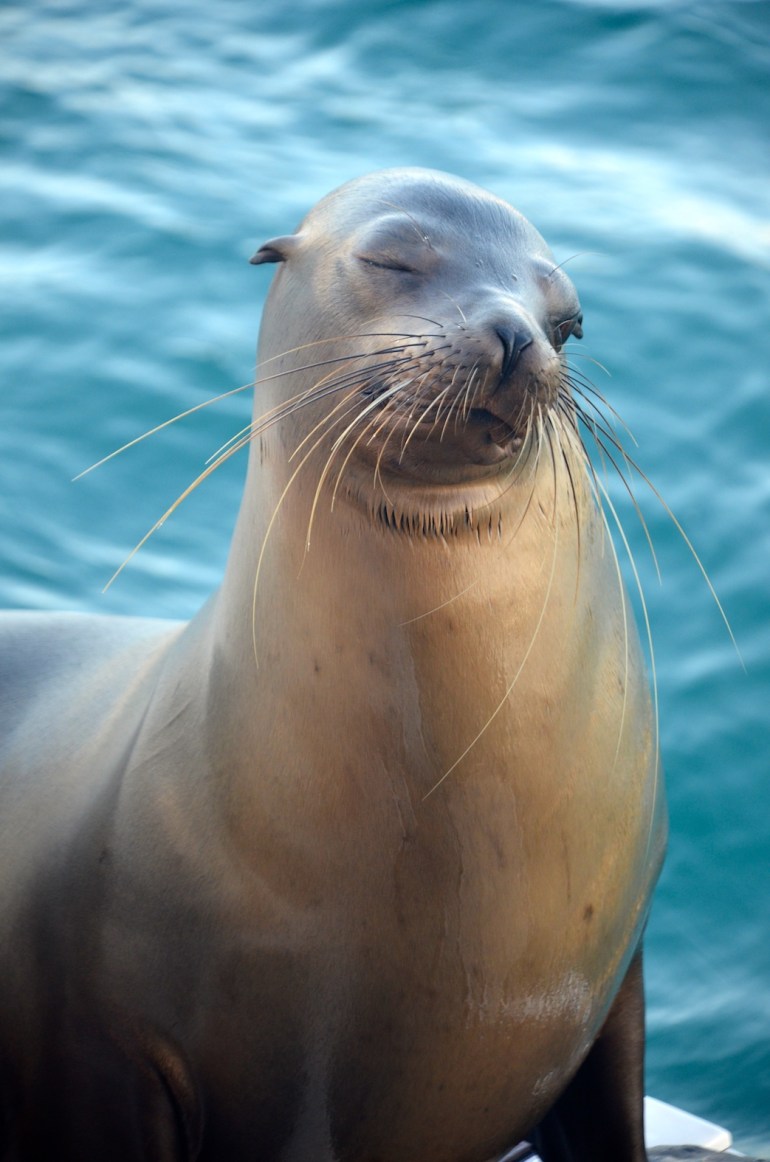
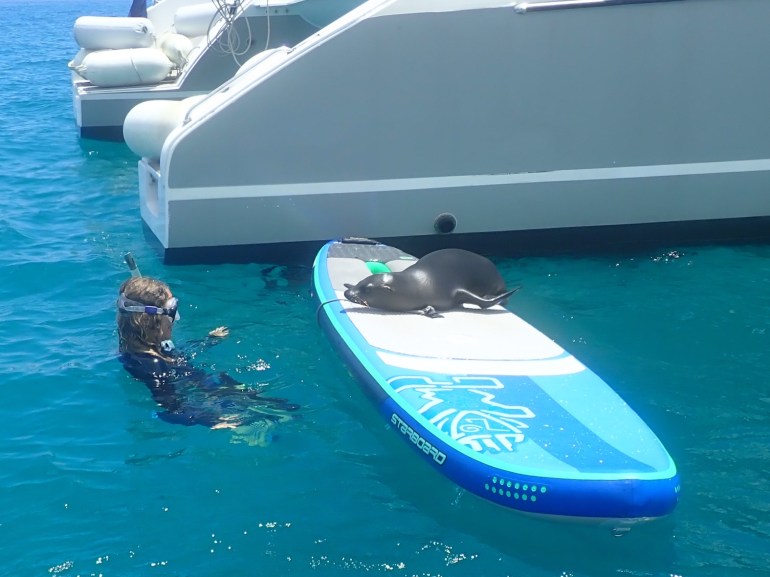
The sea lions here really steal the show.  They are everywhere, living all over town, swimming round every boat and hauling out for a nap on any flat surface available. 15,000 individuals live here, and sometimes it sounds like they are all within honking range of the boat.  Hundreds of them on every beach, all around the rocks, lounging on any moored boat or pontoon they can climb on to.  Most sailing boats have rigged a defence system of fenders to prevent mass boardings, the sea lions would love to be lounging on our cockpit cushions given half a chance.

IMG_2727

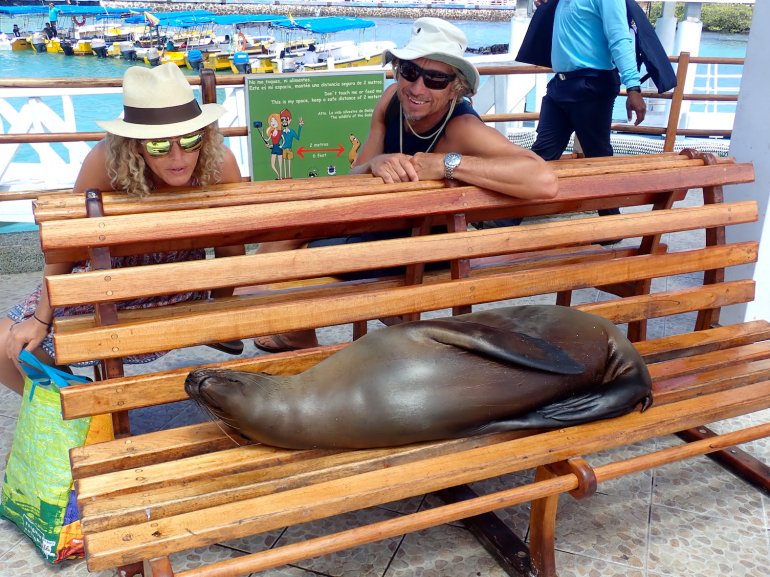
They think they own the place here, sprawled out sleeping on the public seating along the harbour front.  They will tolerate humans nearby as long as we don’t disturb their lazy nap in the sun.

OLYMPUS DIGITAL CAMERA

They are so entertaining.  The young pups bleating for their mothers, grumpy old bulls barking, snorting and harrumphing around the colony.  Families curled up together, lying in the sun until one of them changes position, disturbing everyone’s sleep so they all have to wriggle around to get comfortable again.  Adolescents romping through the sleeping mass and jumping on everyone.  The very comical way they move on land and seem to be continually exhausted and only capable of lying in a heap.  We find we can watch and enjoy all this behaviour every day.

OLYMPUS DIGITAL CAMERA

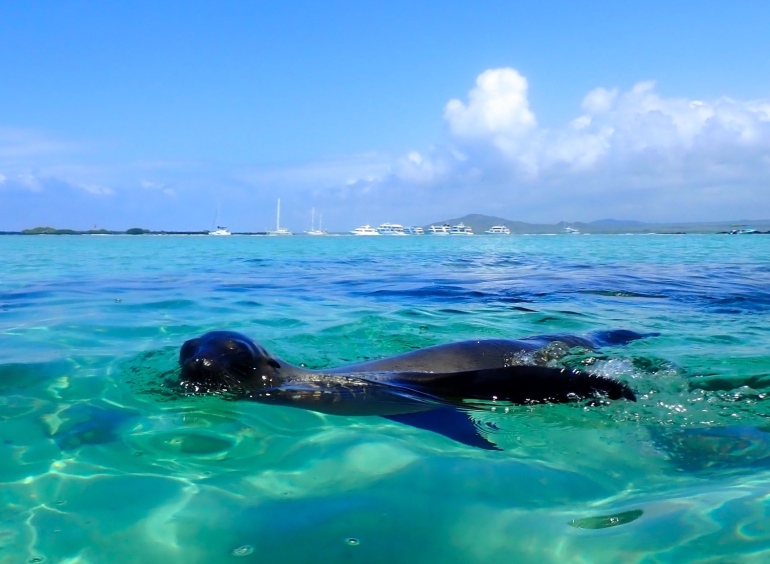
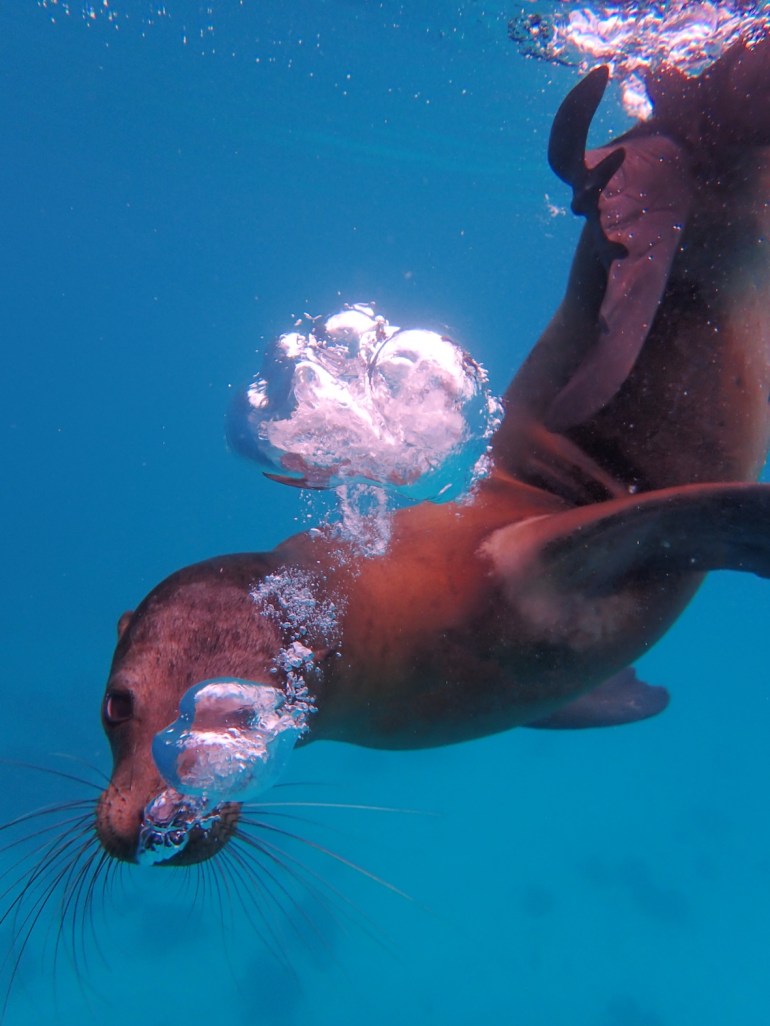
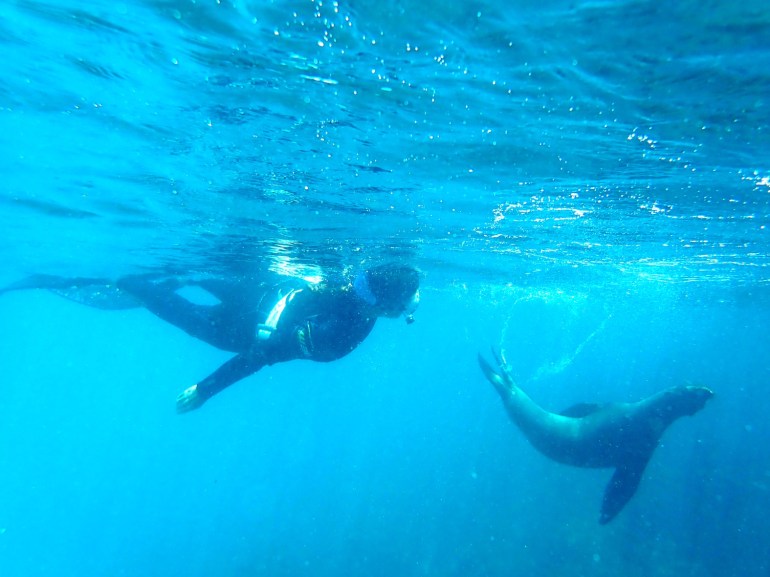
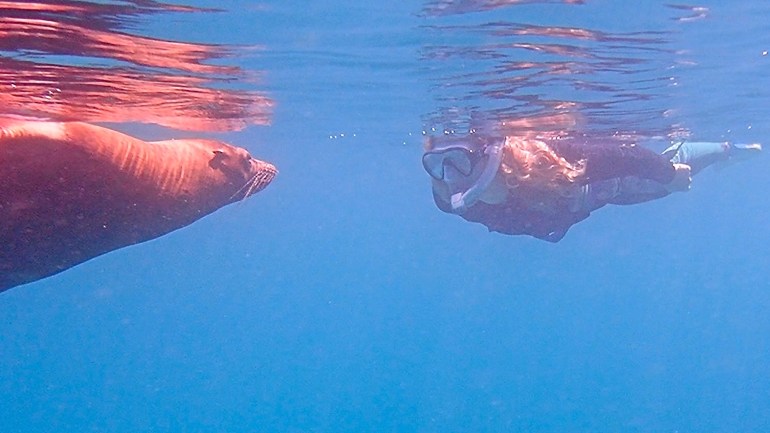
But then you see them in the water.  We have been joined by excited pups on several snorkelling trips now.  At times they swim straight for us at high speed, porpoising with excitement to come and play with human swimmers.  Then they will cavort around us, coming closer on each pass, gaining in confidence, jumping over us.  Lithe, sleek, twisting bodies, changing direction so fast and gliding around us for the sheer joy of it.  It does put a big smile on your face.

OLYMPUS DIGITAL CAMERAOLYMPUS DIGITAL CAMERA

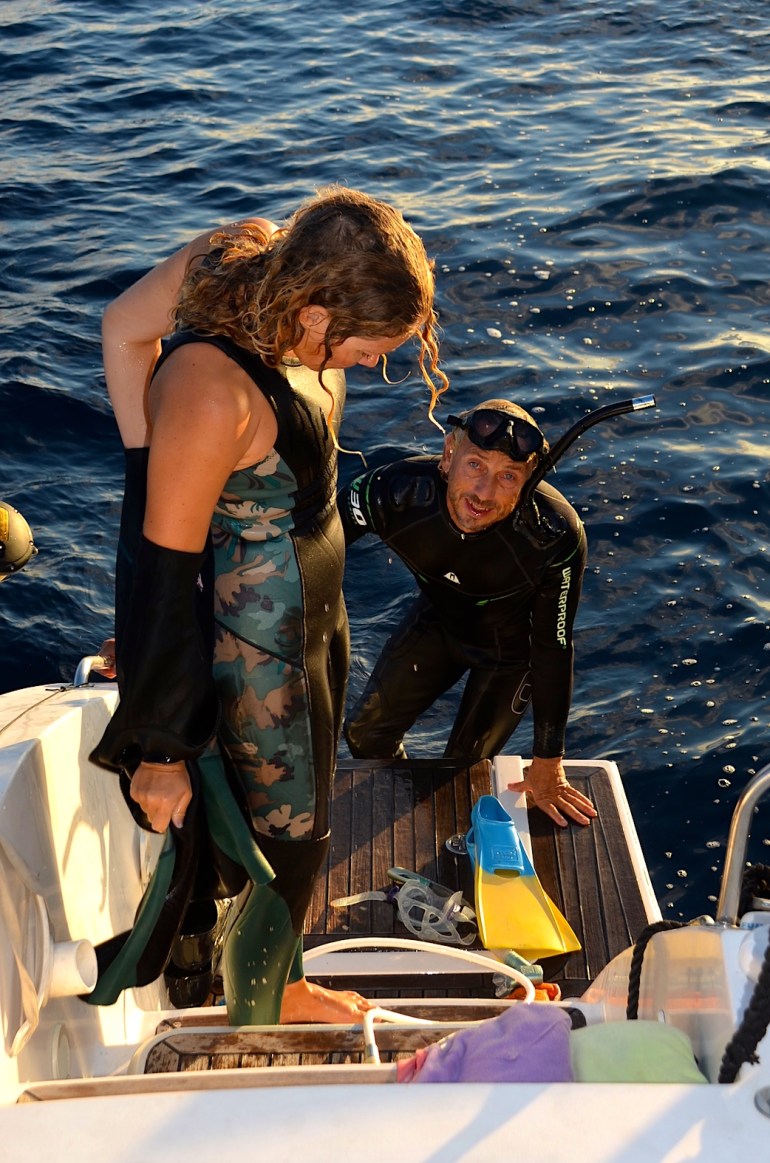
We had a long encounter with one individual.  We anchored our dinghy in about 8 metres of clear water over white sand, pulled our fins on and slipped in to snorkel.

The young sea lion saw us, launched off the nearby cardinal mark he had been lounging on and came leaping over, spinning around us.  Then we started diving with him, I was wearing some weights and could easily go down to the bottom to watch him swimming above.  He seemed to enjoy this and then would repeatedly swim from us straight to the bottom and wait for us to join him.  I would dive down, we both lie on the seabed for a while, looking at each other, then he would zip off and we spiral round each other back to the surface where we both take a breath before he goes back to the seabed to wait for me.  “Again! again!”.  A playful, freediving puppy.

OLYMPUS DIGITAL CAMERAOLYMPUS DIGITAL CAMERA

This seems like a pretty intense interaction with a wild sea creature and we were all buzzing from it.  Between us we have swum with dolphins and whales in a few different scenarios, but this contact seems different, much more personal.  The sea lions are actively engaging with us.  Friendly, unafraid, inquisitive and playful.

OLYMPUS DIGITAL CAMERA

It’s easy to (mis?)interpret some of the behaviour as cheeky humour.  We were all resting between dives on the glassy, sunny surface.  The sea lion approaches Jemima horizontally, almost motionless, putting his whiskers right up to her mask, they lie there for a moment eye to eye, then the pup blows a huge bubble in Jemima’s face and cavorts off.  I’m sure he was laughing as much as we were.

Face to Face 2

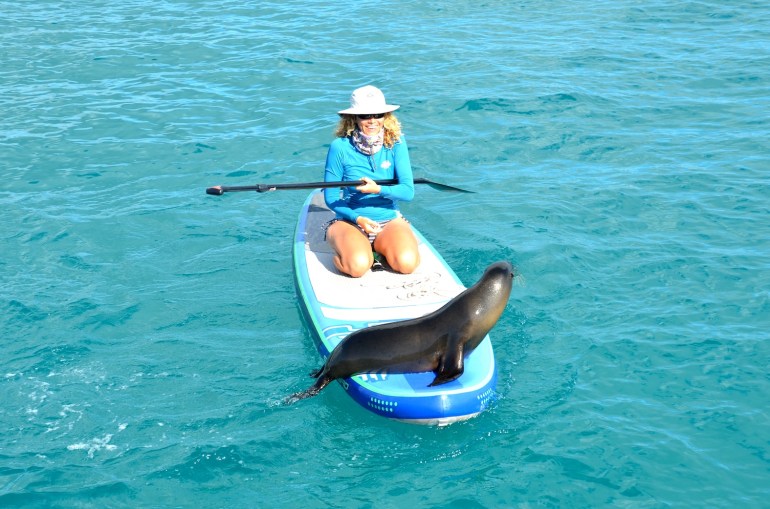
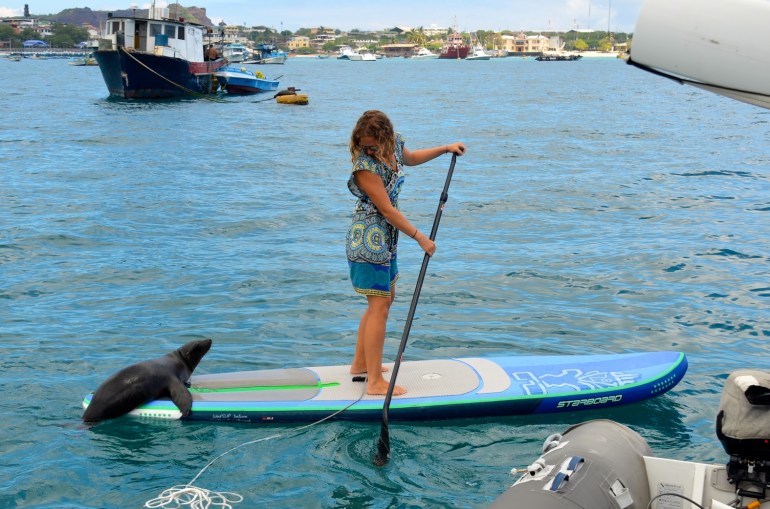
After a few days the pups in the local ‘nursery’ area of the anchorage have become so accustomed to Jemima’s regular visits on the paddle board, they are now coming for rides on it!

DSC_8239OLYMPUS DIGITAL CAMERADSC_8225

Surf

I’m tired tonight after a full day in the Galapagos.  Paddleboarding, a boat trip, two scuba dives and a surf session.

Surfing arrived here relatively recently, and it arrived on sailing boats like ours, bound for Polynesia.  A few decades ago those surfing sailors would have been anchored where I am now, and could not have failed to notice the quality of rights and lefts wrapping around the points on both sides of this natural harbour.  The surfboards came out of the yacht lockers and the locals took note.  The new generation of San Cristobal kids are now charging the waves in their backyard and loving it.

DSC_8070

There is a great Galapagos flavour to the surfing here.  A water taxi will pick me up from Escapade, drop me at the peak and come back for me at sunset.  Black volcanic boulders everywhere, marine iguanas patrolling the rocks, huge turtles in the water, the ever-present sea lions riding inside the waves at high speed.

As we sat at an empty break one Saturday morning, a visitor from mainland Ecuador told me the locals are complacent, or surfed-out, having too much fun.  There is no shortage of waves, look at where this archipelago sits on the equator.  Swells from the North and South Pacific arrive year round.

OLYMPUS DIGITAL CAMERA

But it’s also in the doldrums, I haven’t rigged my windsurf gear since Panama.  Even if there was wind, I’m sure it’s not allowed, might disturb the sea lions. (But they would love it!)

Tortoises

DSC_8183

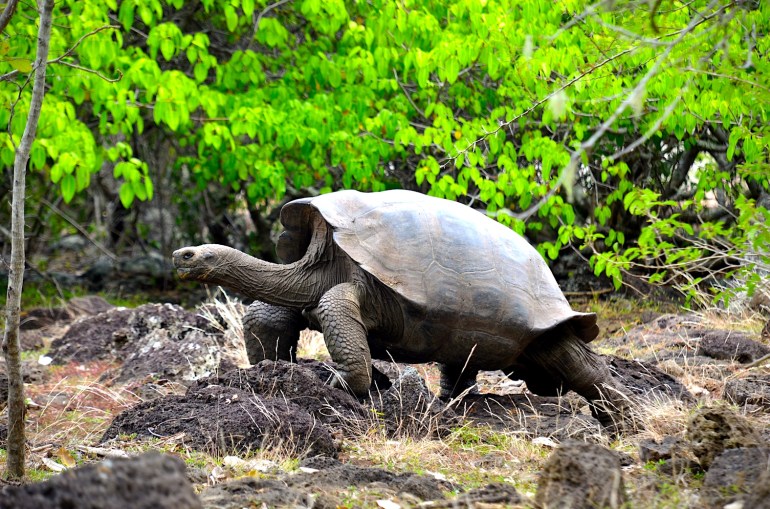
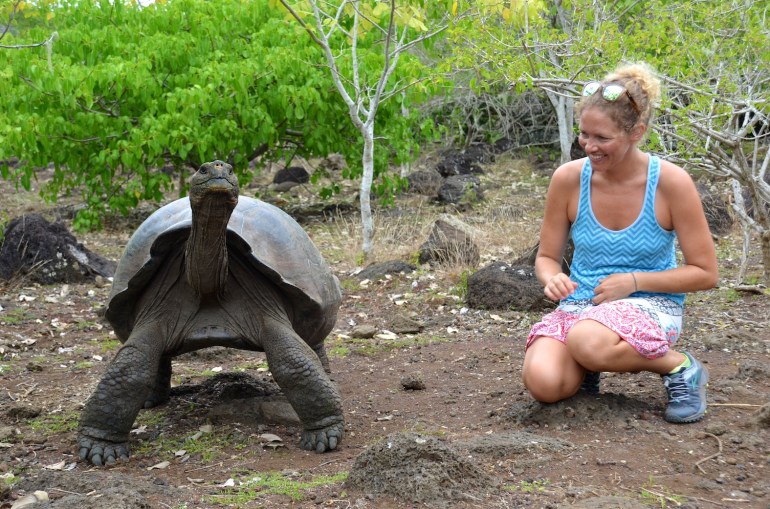
There is a limited road system on San Cristobal, well one road really, across the southern part.  The whole of the rest of the island is wild national Park with no access.  We took a taxi down ‘the road’ to visit the breeding centre for the Galapagos Giant Tortoise. They are to be found foraging in the hot, dry vegetation, plodding heavily through the bush.  Magnificent creatures, the eldest of which may have been plodding here since the late 1800s!

DSC_8204

Scuba

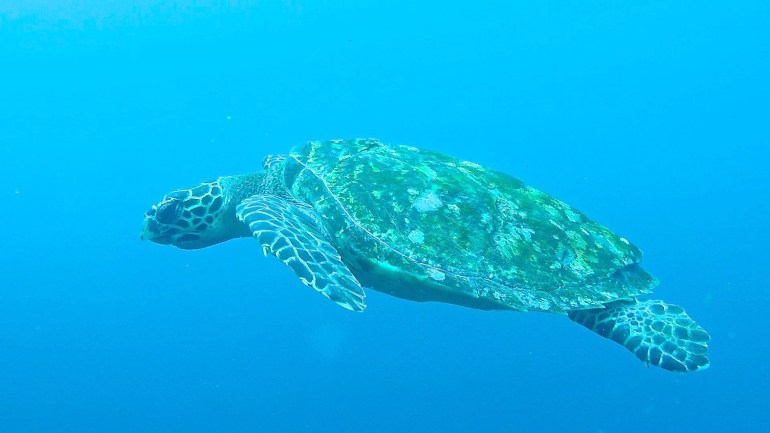
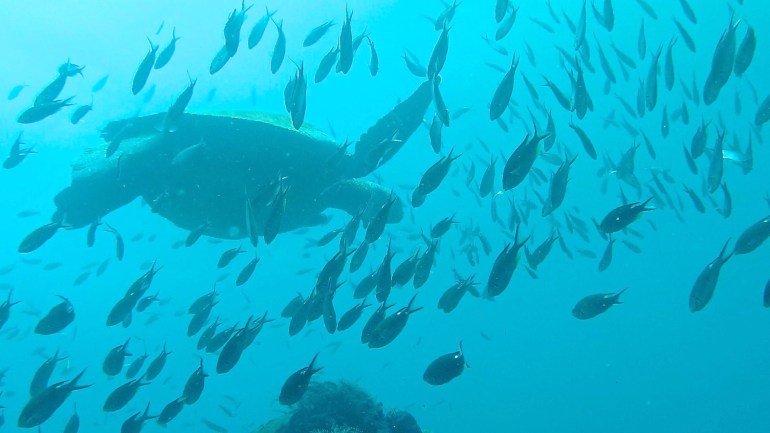
We dived the cold waters around the walls of Kicker Rock, 7mm wetsuits and plenty of lead, with lots of fish, sharks and turtles.  Many of these fish are new to us, as is the endemic Galapagos Shark, streamlined silhouettes circling above us.  We tried to pick a low-swell day for our dive trip, but visibility was not great in the churning waters around the rock.  We have a few more dive sites on our Galapagos to-do list.

TurtleDCIM100GOPROGOPR5268.GOPR5276aOLYMPUS DIGITAL CAMERA

Next island

After nine days at anchor here it’s time to move on.  We are leaving for the next stop on our Galapagos tour.  Isla Santa Cruz, 45 miles to the west.

DSC_8093DSC_8218OLYMPUS DIGITAL CAMERAOLYMPUS DIGITAL CAMERAOLYMPUS DIGITAL CAMERAP4220360b

Bound For Galapagos

DSC_7871

Day 1

Farewell Panama.

Thanks for everything!

Our first full day at sea.  I think I already mentioned that this sea seems to be teeming with life.

Today started with a fin whale close by as we left the last of Las Perlas astern.

Then the manta rays started jumping.  Really jumping!  High back flips, all around the boat.  Mating displays?

The breeze was light and variable all day.  Sometimes we were reaching at 9 kts, then barely creeping along at 3 or 4.

The afternoon was glass calm, Escapade still somehow gliding on at 4 kts.  Big manta rays on the surface all around, 2 metre wingspan.

DSC_7758

Dolphins, turtles, schools of fish.  We landed another Spanish mackerel, protein for the day.

This evening the sea was glowing, mesmerising, the three of us each quietly absorbed in the beauty of it all.

We’re not used to sailing in such light wind, it’s very quiet and peaceful, and very satisfying to be crossing the smooth sea at the same speed as the wind.

IMG_2659

The wine-dark sea.

I think that’s the title of one of the Jack Aubrey books, the HMS Surprise sails in to an unnatural dark red sea and her superstitious crew consider it an ill portent.

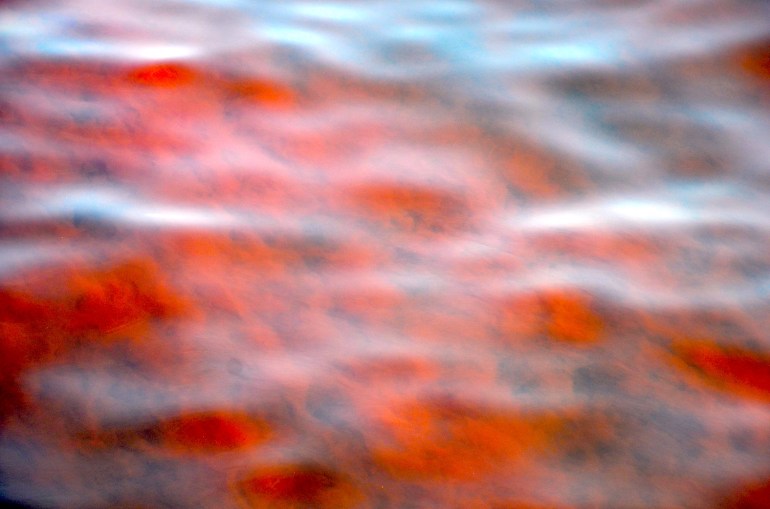
Well today we crossed a vast red patch, my marine biologist daughter tells me it is caused by the upwelling of nutrients resulting in an algal bloom. Swirling dark red clouds below the surface.

DSC_7724

Tonight the phosphorescence was a good show, fish appearing as comets and a large manta like a spaceship alongside.

Day 2

Off the shelf

After all that marine wildlife, the next day was so different.

We had sailed west, straight off the continental shelf and out into the empty Pacific.  The sea bed 150m below us dropped away to 3,500m. We left the Americas behind, along with all signs of life at the surface. Not a bird in the sky or a single bite on the hook.

DSC_7760

Day 3

The Doldrums

The Equatorial sea areas previously known as the Doldrums seem to have been re-named.  So we are now sailing through the Inter Tropical Convergance Zone (ITCZ), but I think we’ll stick with the old seafaring term.  We are only about 4 degrees North of the Equator now and the winds are lacking in power and consistency. No problem if you happen to have a light boat, a keen crew and some big sails to play with, but we’re not breaking any speed records.  This area is also known for overcast skies and thunderstorms which we seem to be dodging at night.

DSC_7798

Day 4

Malpelo

Sea mounts rise from the ocean floor 3000 metres below, we sailed over one summit just 100m beneath us, an underwater mountain that would be a pretty good size Alp.

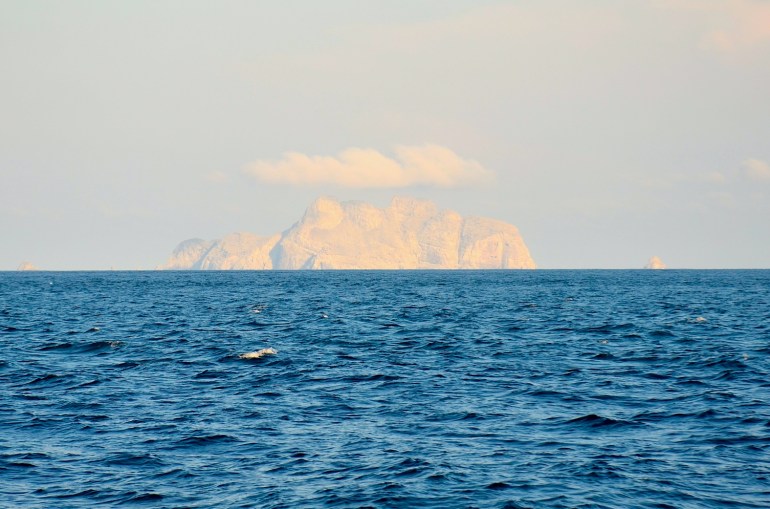
But one breaks the surface, a Gibraltar style rock emerges from the ocean, the tiny island of Malpelo is a Colombian possession, a remote naval outpost.  It is almost on our rhumb line to Galapagos.

DSC_7785

I have heard stories of spectacular diving, pristine waters and huge schools of hammerhead sharks.  We hoped to stop and have a look, but it seems that it’s now off limits to visitors.  Dawn’s VHF request for permission to approach the island was denied by the Colombian Navy, so we sailed on by.

DSC_7796

Scale

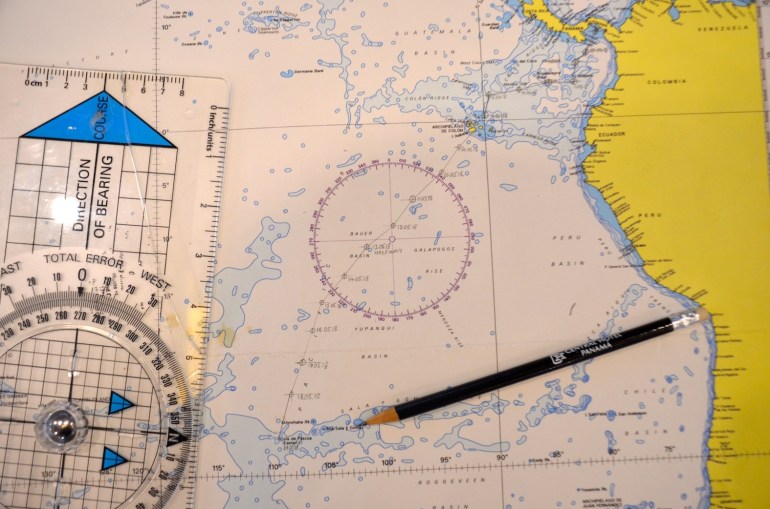
I still like a paper chart.

If you want to buy a nautical chart in Panama City you should go to see ‘Mister George’ at Islamorada International.  He has a huge colour printer and will run off an official, full size Admiralty chart of anywhere in the world, at the touch of a button. We bought a 1: 20,000,000 scale planning chart of the South Pacific.

IMG_2550 2

Now I have had time to unfold it and start to understand the size of the area. It’s daunting.

Our first Atlantic crossing in 2004 was 2,850 nautical miles I think, from Canaries to Antigua. It seemed an epic voyage. The Pacific at the equator is 11,000 miles East to West!  All of the land masses of the world could fit in the Pacific basin with room to spare.

DSC_7838

Day 5

Fish 

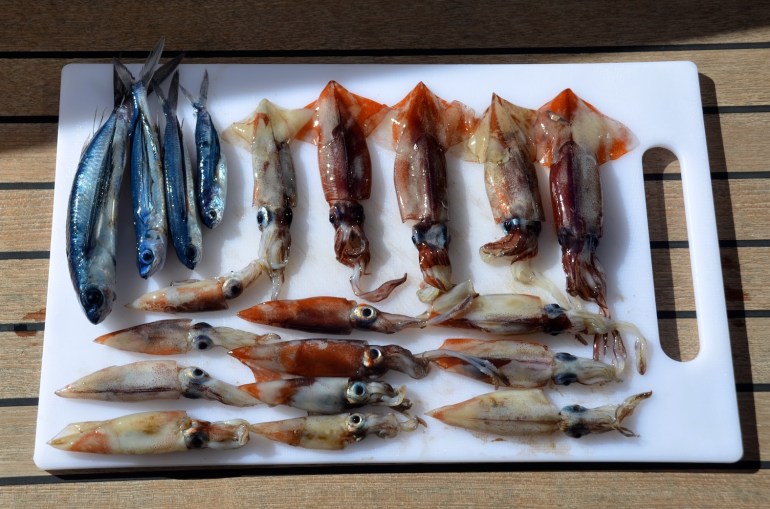
Having trolled a lure from dawn to dusk without so much as a click on the reel, I finally had some fresh fish on board tonight.  Reading in the cabin on my night watch, I looked up to see a fish flapping around on the galley floor.  It can only have arrived through the open hatch in the ceiling, a good 4 metres above sea level, obviously cruising altitude for this flying fish.  He seemed a bit surprised, as was I.  I guess he would have been swimming for his life to outrun a predator, breaking the surface and soaring to windward to escape, only to ricochet off the hatch of a passing yacht.  What are the chances?   Talk about ‘out of the frying pan in to the fire’.

A tiny adjustment to his trajectory would have actually landed him in my frying pan!

He wasn’t really big enough though, and seemed very keen to be swimming again, so I scooped him up and re-launched him into the night.  Good luck.

DSC_7848

Hydro Power

It took a while to run this sea-trial as the wind was not blowing in the doldrums.  When we did finally get up to 7 knots the new generator worked great, 16 amps coming in at that speed, rising to 30+ amps at 10 knots.  As soon as the boat is moving at her usual sailing speeds we have complete power autonomy.  This is really a game changer on passage, not only will it keep all the systems running day and night, without ever having to burn any diesel, it means that we have more power than we can use.  I can run the water-maker anytime, we have switched from gas to an electric kettle.  (Tea consumption is very high on this boat so that saves a lot of propane use.)  We have just sailed all night at about 7 or 8 knots, autopilot driving, and the boat batteries at 100% this morning!

So the tea is hot, the beers are cold, we’re charging laptops willy nilly, I could use an electric drill all day, I might buy myself a hairdryer!

DSC_7852

Day 6

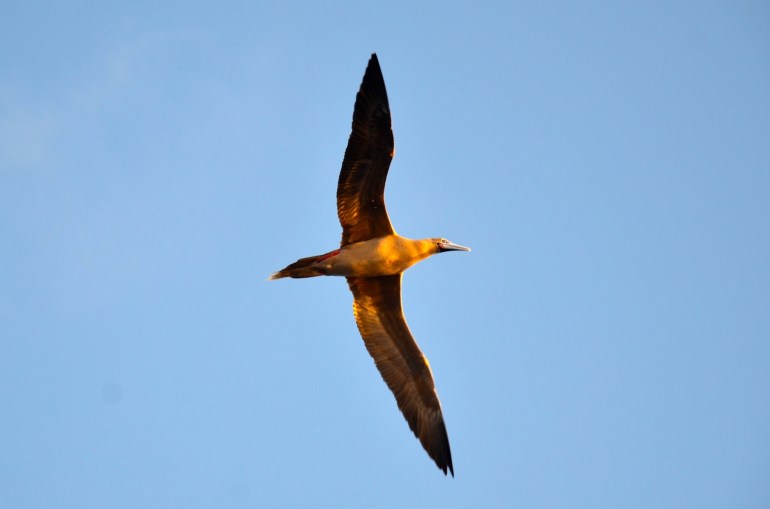
A fine pair of boobies

At night we are joined by birds, usually in pairs, fluttering round the boat using our lights for a bit of night-fishing.

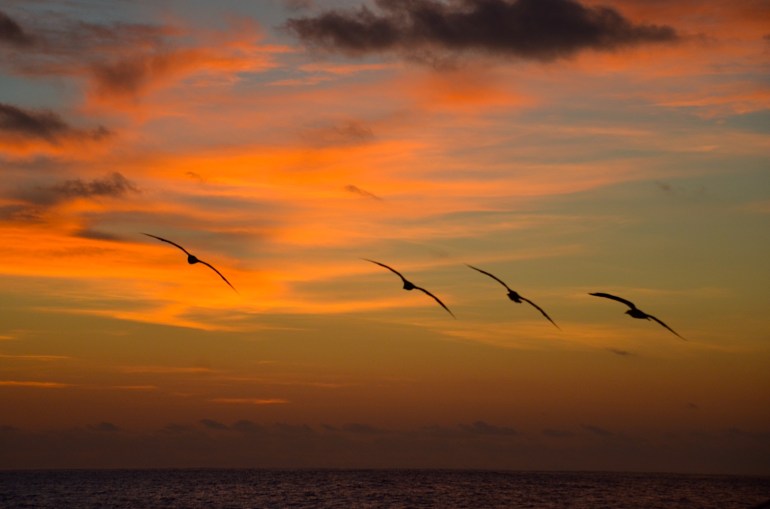
Last night at sunset a pair of boobies were doing laps and riding the airwaves off the code zero headsail.

One landed on the port bow and sat there resting his wings.  We are still 350 miles from Galapagos so there’s nowhere else to perch within a few days flight.

A pod of dolphins arrived and we went forward to see them.  Jemima had taken the booby’s seat, he flew a lap of the boat and tried to land on her head!

DSC_7820

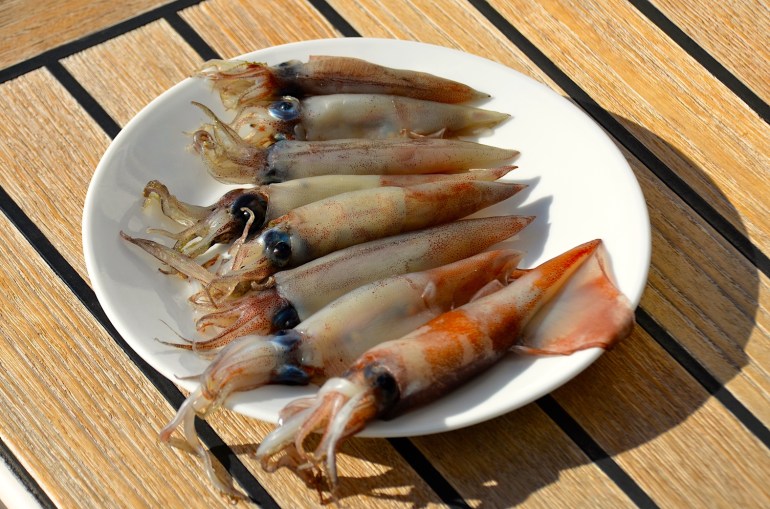
A squadron of squidlets

My rounds on deck this morning were rewarded with this little haul.  Jet propelled protein snacks.

I found them at 7am, before the sun cooked them to the deck.  They were scattered from bows to transoms, ink splattered everywhere.

Now cleaned and in the fridge, to be fried with some garlic at lunchtime, and served with a chilled glass of wine perhaps.

DSC_7833

Ship’s stores

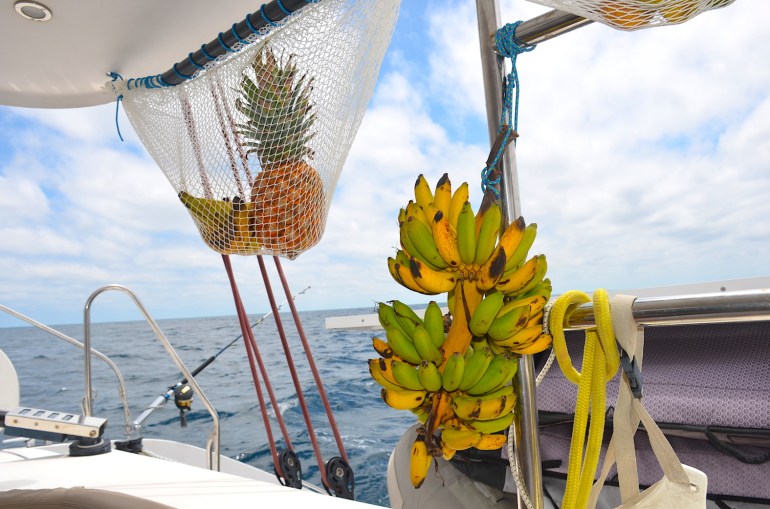
It’s two weeks since our trip to that market, and 6 days at sea on this passage.  The on-board tomato ripening program is going well.  We ate the last avocado this morning, our daily papayas are coming to an end, last mango is ripe, the miniature green bananas are turning yellow at a manageable rate.  We still have lettuces, broccoli and plenty of cabbages and 50 limes, so we are keeping the old scurvy at bay for now.

DSC_7837

Keeping busy

Dawn and I are used to sailing without crew, so having Jemima on board makes life much easier.  The night is split into three watches of four hours each, so we all get 8 hours sleep.  Luxury!  The code zero and full main have not been touched for days.  Escapade is cantering along at 8 and 9 knots to windward in a 10 kt breeze.

DSC_7842

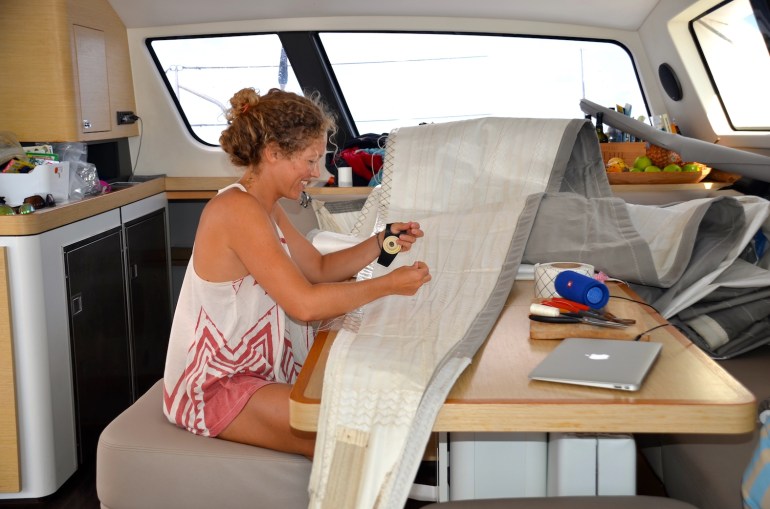
So days are filled with eating, reading, music, sewing, workouts, fiercely competitive Scrabble sessions, charades, an audio book of Darwin’s 1835 voyage on the Beagle, and lots of gazing at the ever-mesmerising ocean gliding by.  But our main pre-occupation is food.  The discussing of options, menu ideas, planning, preparing and consuming three square meals a day, plus elevenses, afternoon tea and of course sundowners.  Don’t forget treats for the nightwatch.

DSC_7916

Day 7

Equator

The funny thing is, it’s getting colder.  The heat in Panama was up there at the top end of our operational temperature range, day and night.  That was about 5 degrees north of the equator.  Since we have been sailing south, the temperature has dropped quite a bit.  This morning we are only 2 degrees north of the line and there is a chill in the air.  We are attributing this to the Humboldt current bringing a touch of Antarctic freshness to us via the coast of Chile.  That would also account for the penguins swimming around the Equator in Galapagos.

DSC_7791

DSC_7943

90 Degrees West

A less significant meridian this one, but 90 degrees west of Greenwich means that Escapade will have sailed a quarter of the way around the world.

I don’t need much of an excuse to start chilling a bottle of fizz for sunset and 25% of a circumnavigation is surely a worthy cause?

The Big Blue

Only the cleanest bottoms are allowed in the Galapagos.

The rules of the national park ban any foreign barnacles from arriving and we have heard tales of yachts being sent back out to sea to scrub off any growth before being allowed in.  We’re about 100 miles off, the wind died away tonight so we dropped the sails and jumped in for a sunset swim to check the hulls.  They were still spotless as you would hope, having been recently antifouled.  I polished up the props and I’m sure we will pass any inspection.  It was great to be swimming round the boat again, although we’re not used to that glowing mid ocean blue.  A few gossamer jellyfish drifting by, lit by low evening sun. Nearest land is only a mile away… straight down.

DSC_7927

Day 8

Landfall

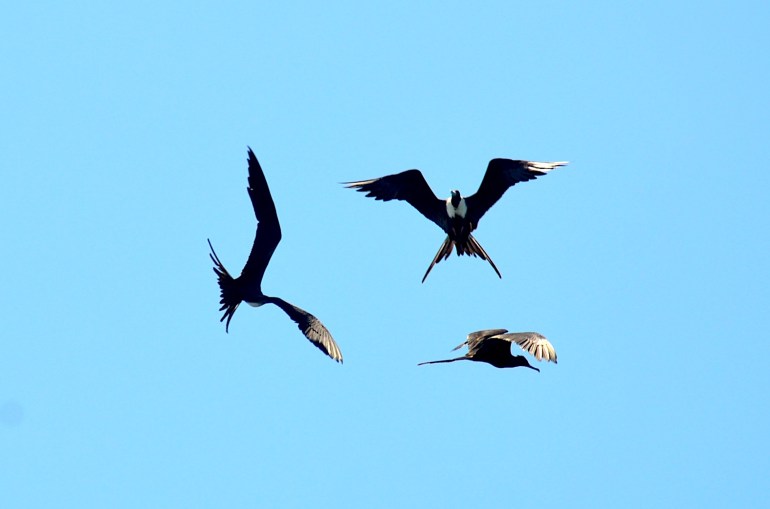
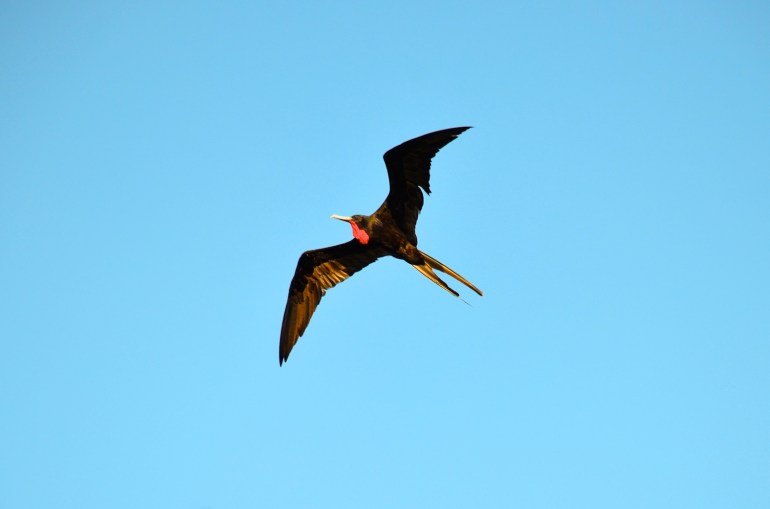
Our first Galapagos island on the horizon at 8am, Isla Genovesa.  As we trolled our line into the fishy waters close to the island, we attracted a large and noisy crowd of frigate birds all swooping down on the lure.  We thought that announcing our arrival in the Parque Nacional with a drowned seabird in tow would not be a good look, so I quickly reeled in while Dawn tried to scare them off with a fog horn!  Disaster averted.

DSC_7932

Crossing The Line

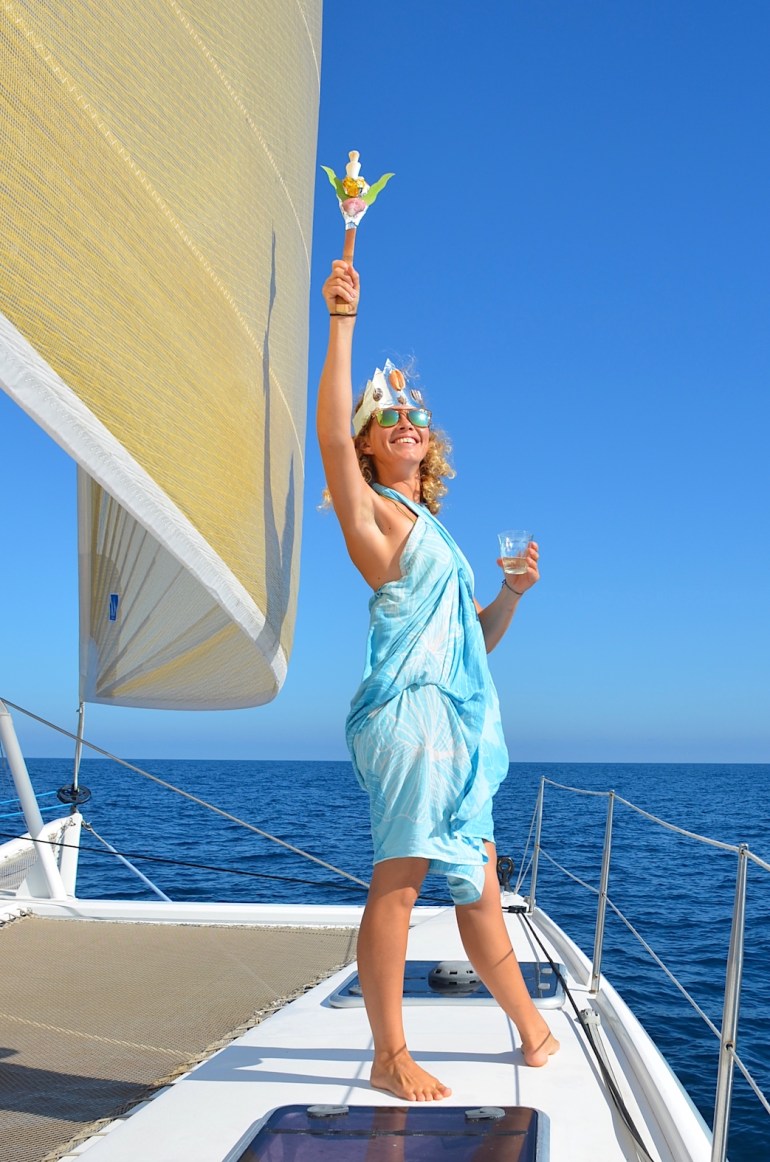
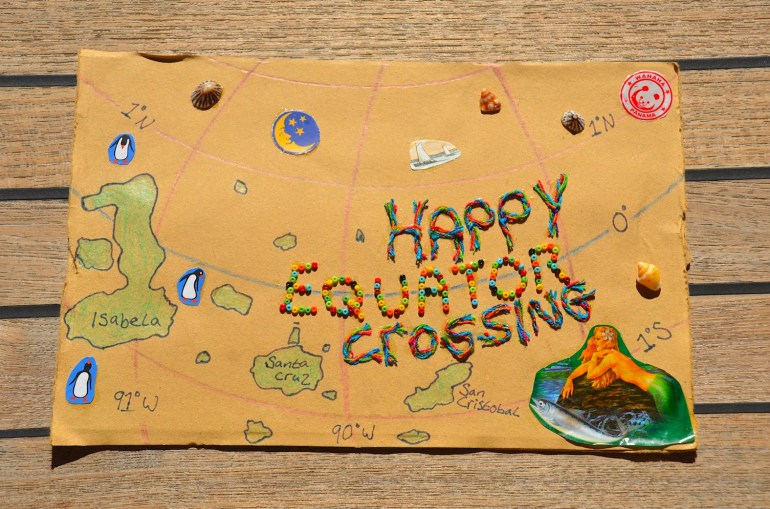
Ceremonies to mark the passing of a ship over the equator have been a naval tradition for hundreds of years.  It was seen as a rite of passage for new hands and an excuse for a bit of dressing up and nonsense for everyone else.

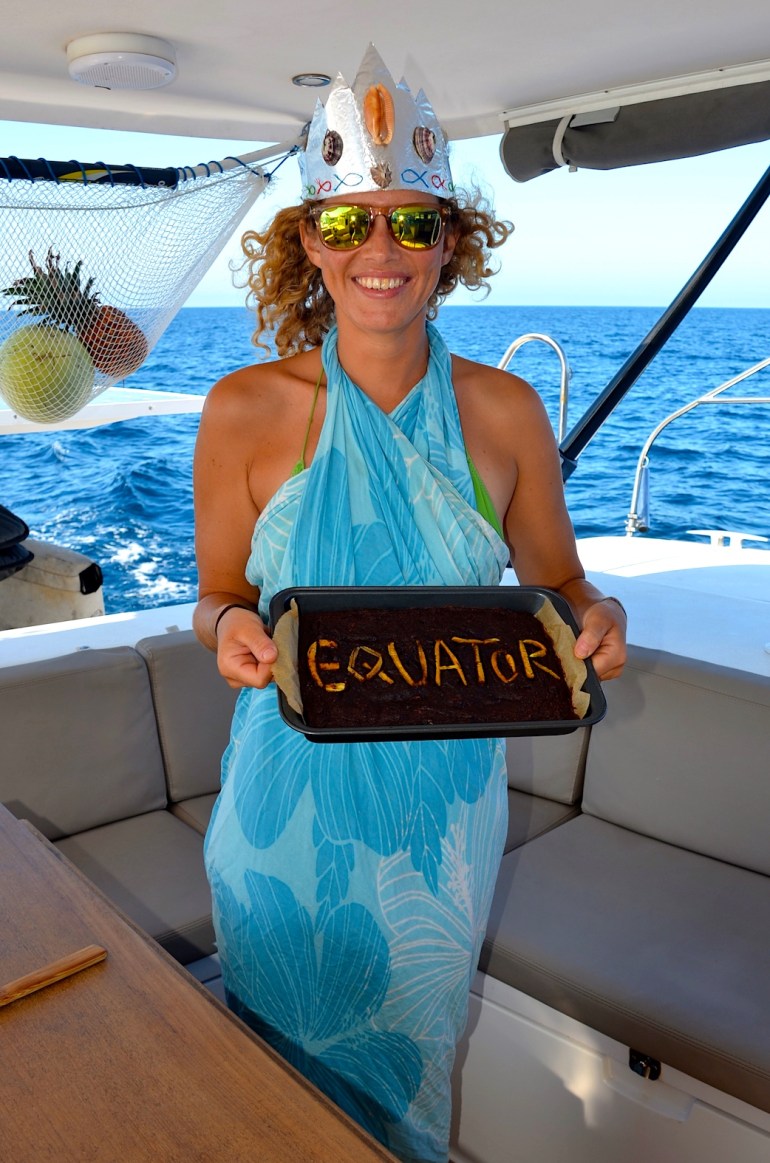
Dawn and I are sailing across for the first time, so we are ‘pollywogs’, about to become ‘shellbacks’.  Jemima has crossed the line already so she was to preside over the ceremonies.  Around 14:00 she appeared as ‘Queen Codfish’ (standing in for Father Neptune) in a glorious home-made costume decorated with shells from Las Perlas.

DSC_7968

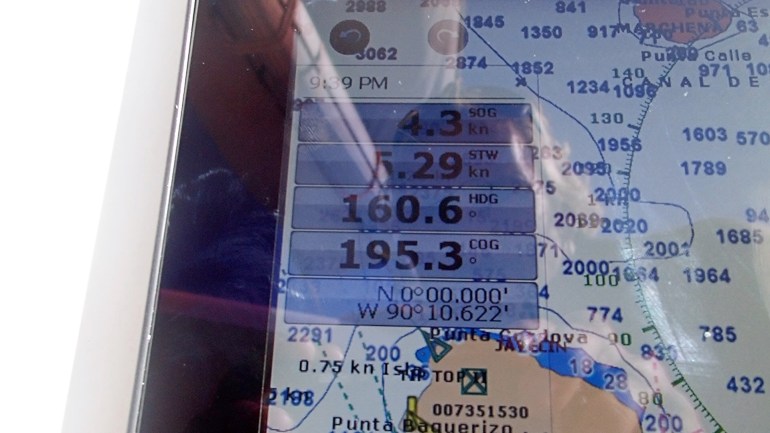
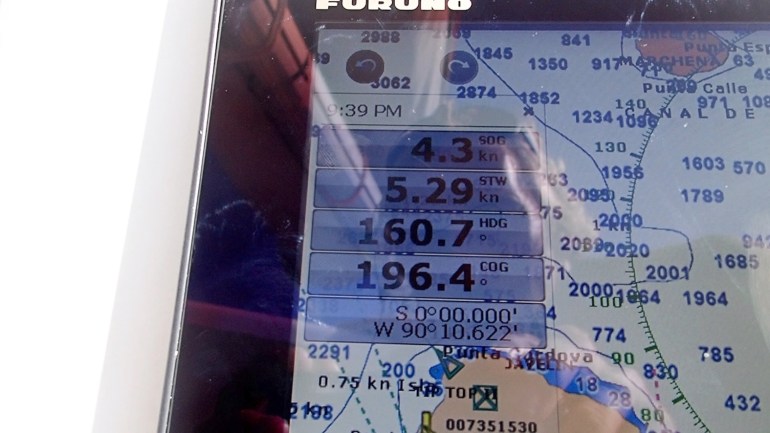
The first requirement from us was to ‘enliven her spirit with fruits of the land’ so a bottle was opened.  Offerings were made to Neptune in the forms of song and dance to request safe passage.  We sat by the chart plotter and watched the numbers click down to zero and the N became S.

P4160018

Welcome to the Southern Hemisphere!

P4160018b

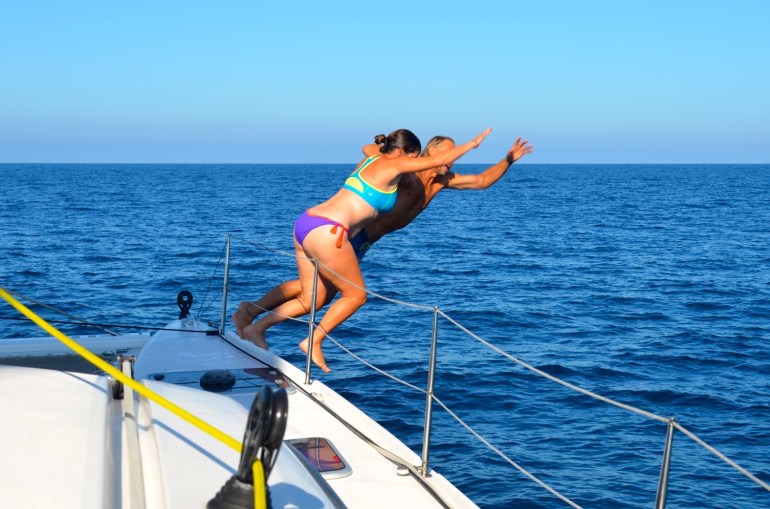
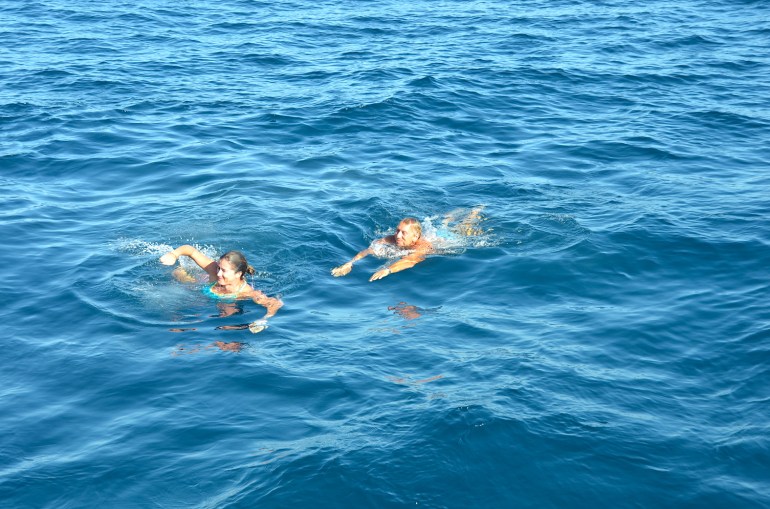
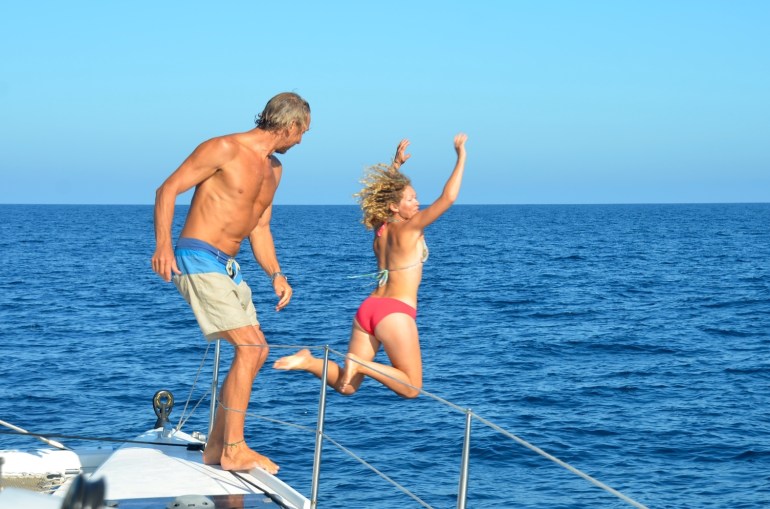
We furled the headsail, circled round again and jumped in to swim across the line.

DSC_7987DSC_8003DSC_8005

Celebrations continued with Jemima’s chocolate and banana Equator Cake.

DSC_7956

DSC_7953

Day 9

San Cristobal

The little town of Puerto Baquerizo Moreno sits on the shores of Wreck Bay.  We sail in, drop anchor and sails at about 9am.  A few minutes to savour the stillness before we are boarded by uniformed representatives of Customs, Immigration, Quarantine, Ecological Service, plus our agent, a diver to check our bottom (“limpio!”) and a fumigation team to exterminate any Panamanian insects who may have stowed away.

Time to go ashore to stretch our sea legs and celebrate a long passage with light winds all the way, but almost all of it under sail.

Our Galapagos exploration begins..

DSC_7942

OLYMPUS DIGITAL CAMERA

Quiero Viento


OLYMPUS DIGITAL CAMERA

It is very hot and the wind is not really enough to motivate us to hoist a sail. We are waiting for some breeze to take us 850 miles across the Pacific to the Galapagos. Our GRIB file forecasts are relentlessly light and variable.  So we have had a few days island hopping in Las Perlas.

OLYMPUS DIGITAL CAMERA

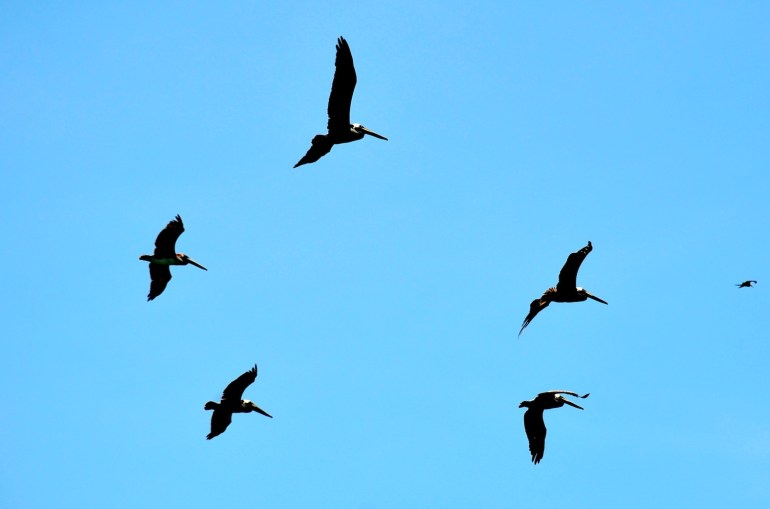
Our first anchorage at Pachequa was surrounded by so much life, in the sea and the air.  Squawking seabirds in vast numbers. Pelicans dive-bombing, whole colonies of cormorants taking flight, fish jumping, dolphins never far away.

DSC_7577DSC_7548

We made our way to Isla Contadora with the promise of a bar or restaurant, we found both and had a memorable return trip to the boat that night. 3-up on the paddle board splashing towards Escapade through bright bioluminescent sea.

DSC_7573

Next anchorage was a hot swampy lagoon. Just us and a million birds. We were too worried about crocodiles to swim.

DSC_7679

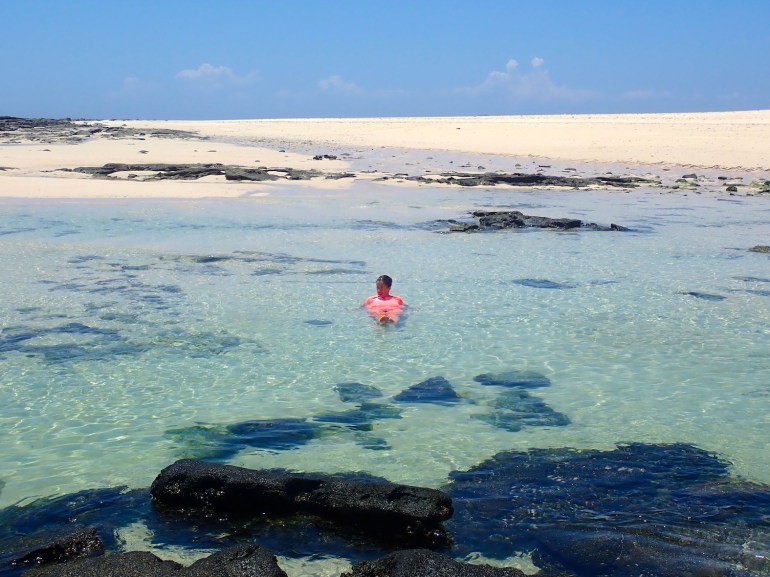
The following day we found the pearl in Las Perlas. The tiny islet of Boyaneta is a bank of white sand on a ridge of rock. Clear water to cool off in, no sign of crocs. A wild and beautiful speck of land.

OLYMPUS DIGITAL CAMERAOLYMPUS DIGITAL CAMERA

I am loving the freedom to explore again. Open the pilot book, pick an island and plot a course, nobody around, go where you like and probably catch supper on the way.

OLYMPUS DIGITAL CAMERA

We visited the village on Isla Pedro Gonzales and threaded the narrow and shallow channel Ventura Cruz through the jungle to Isla del Rey.  While we were keeping an eye on the depth and calculating the tide, we couldn’t help noticing the sharks and crocodiles in the channel, so no swimming there.

OLYMPUS DIGITAL CAMERAOLYMPUS DIGITAL CAMERAOLYMPUS DIGITAL CAMERAOLYMPUS DIGITAL CAMERAOLYMPUS DIGITAL CAMERAOLYMPUS DIGITAL CAMERA

We plan to leave tomorrow, next post should be from The Galapagos, wind permitting!

A whole new ocean.

OLYMPUS DIGITAL CAMERA

Getting out of Panama was starting to feel like one of those dreams where you just never quite get where you’re trying to go.

The weeks went by, antifouling, waiting for a rigger, waiting for the Watt & Sea, installing it, waiting for the canal transit date, provisioning, last minute jobs.

Living in a marina, which is not our natural habitat, using our shore-vehicle fleet: two folding bikes and a skateboard to get the three of us out to dinner.

Finally the morning arrived for us to cast off the lines and sail away.

DSC_7514

How different can it be? Another stretch of tropical sea, a few miles from the one we just left.

But it is different.  We are now entering the largest expanse of ocean on the planet.

Let’s see, the first difference is that there is no wind!  At this time of year the trades blow reliably and strong on the Caribbean side, but over here they are light and fickle.  Caribbean Panama sees plenty of cloud and passing rain squalls, over here it’s blue skies.

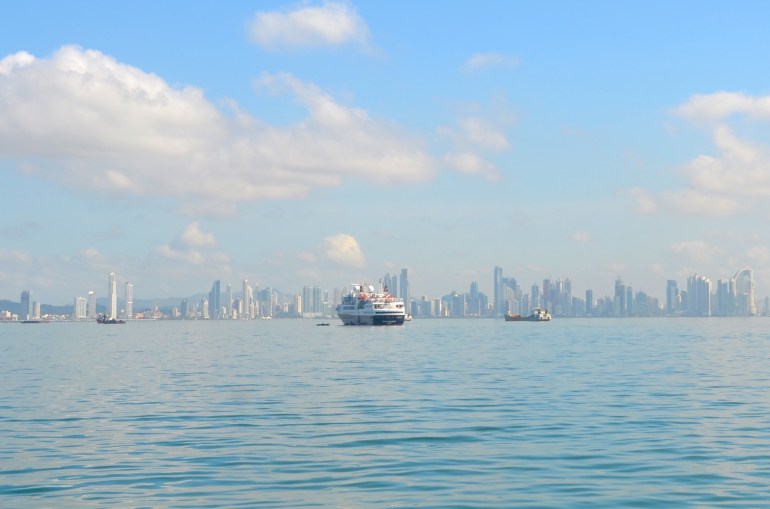
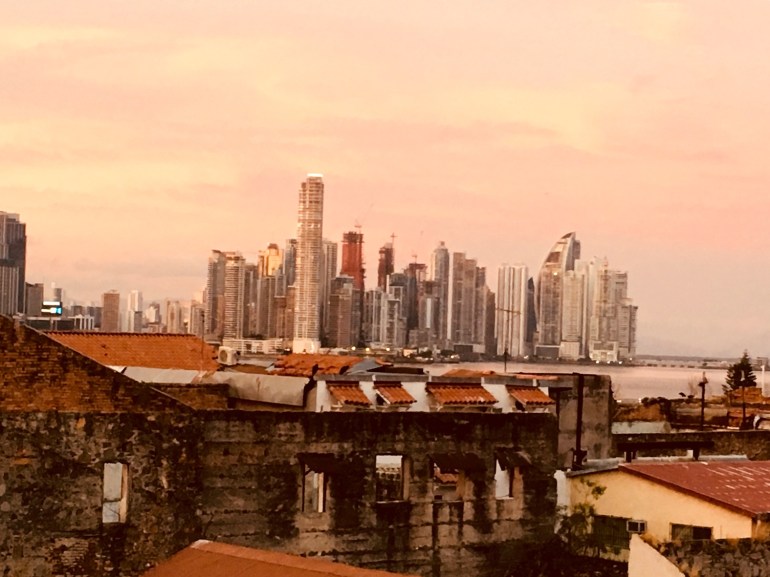
We motor away from the Panama City skyline with zero wind, past the last of the anchored ships and all the canal traffic, out into the smooth blue world with a low long swell sliding under us.

DSC_7559

The beginnings of a breeze reach us, we hoist main and gennaker, turn off the engine and we are ghosting along at windspeed, 4 or 5 knots in silence. The simple pleasure of feeling Escapade under sail again at last.

DSC_7523

Large numbers of rays are swimming past, great packs of 20 or 30 at a time, close to the surface.  They look like mantas, but small and golden brown.  Haven’t seen those before.

DSC_7550

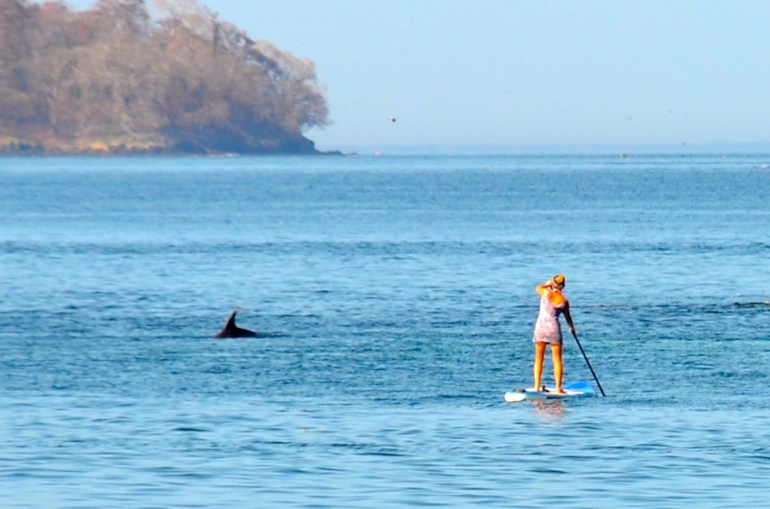
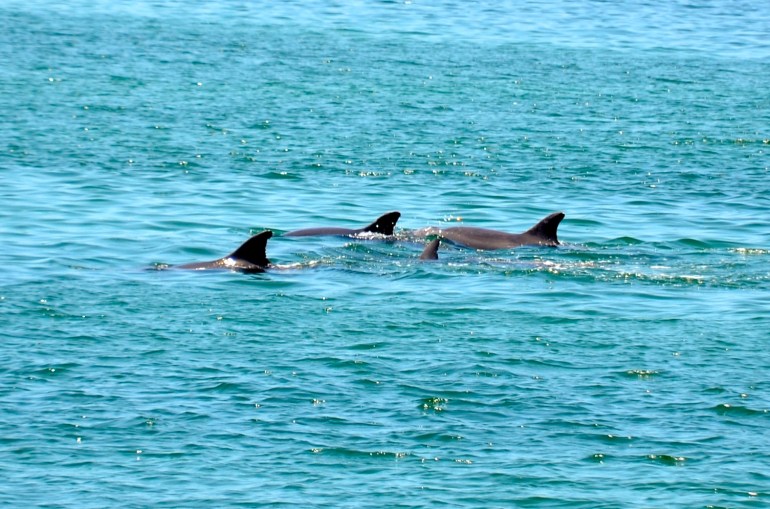
A few spotted dolphins join us briefly, but they are distracted by the rays, ambushing them in what looks like a feeding frenzy now astern.

DSC_7599

The skies are full of sea birds, wheeling above shoals of fish.  The sea is full of life!  Whales surface close by, my new fishing lure attracts a nice bonito for our lunch.  (And dinner).

DSC_7551DSC_7533

By now the wind and boat speed are creeping up to 9 knots as Jemima tiller-steers us round Isla Pacheqilla, the northern most of the Perlas, our first Pacific island.  We sail on to Isla Pachequa, furl the kite, drop the main and anchor off a white sandy beach, densely covered by the colonies of pelicans, frigates, cormorants and egrets.  The pungent scent of guano wafts over the bay!

DSC_7643DSC_7621

Tides are not really part of life in the Caribbean, except perhaps to time the best current for a trip.  But anchoring here needs to be carefully calculated, there is a 5 metre range, Dawn is consulting a tides app for the first time in years. Get this wrong and we could wake up sitting on a rock.

DSC_7593DSC_7582DSC_7587

Now humpbacks are breaching, bottlenose dolphins slowly cruise by and the air above us is dark with birds.  So yes, it all feels new and different.  The plotter shows this anchorage is still only 45 miles from the Caribbean, but we are floating in a whole new ocean.

DSC_7570DSC_7574

Across the Great Divide

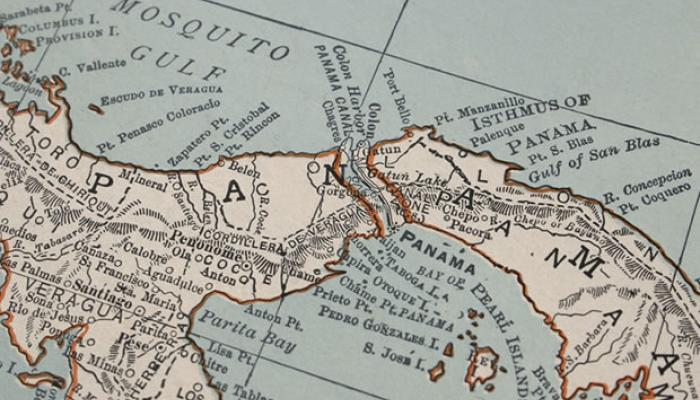
The two giant continents of North and South America were connected by a tiny thread of land, just 30 odd miles across, until 1914 when the Panama Canal opened for business. And what a business! An audacious civil engineering project that included the biggest dam ever built, the world’s largest man-made lake, and the locks which were world’s largest concrete structures at the time. It was superbly conceived and executed in the era of steam trains. The flooding of high valleys to create a 30 mile wide inland lake, requiring locks and cuts to connect to the two coasts. The whole enterprise runs on simple mechanical principles and gravity. It has operated flawlessly every day and night for over 100 years.

IMG_2589

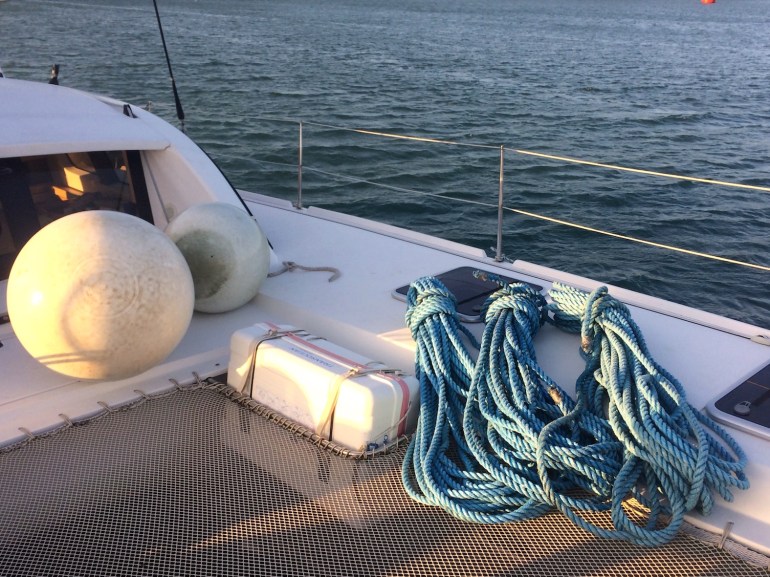
It was our great privilege to take Escapade through this extraordinary feat of engineering. We left Shelter Bay Marina on the morning of the 29th March. Decks loaded with rented nylon lines and fenders for the locks. Our friends Josh and Suzee were aboard as line handlers, joining Dawn, myself and Jemima. Spirits were high, everyone excited to be on our way at last. I was a little jumpy, checking all the systems and instruments were working, trying to remember how to drive the boat after the long lay-up. We had one of those cylindrical radar-reflectors that sit at the top of a shroud. Lots of UV up there, it must have degraded, then filled with rain in the wet season, and the motion of the boat leaving the harbour was enough to shake loose the cooked cable ties and allow the water-filled plastic cylinder to start it’s journey towards the deck 60ft below. This brittle plastic water-bomb landed inches from my head in a spectacular explosion, starting the trip with a bang and doing nothing to calm me down.

Bridge

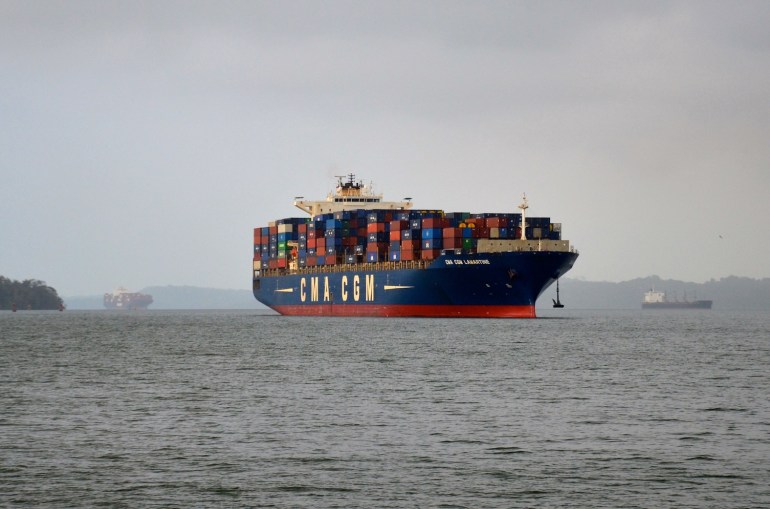
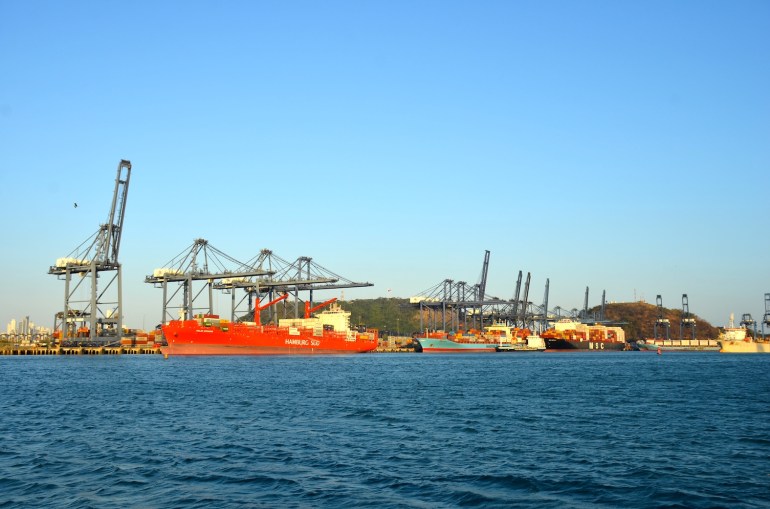
We arrive at the anchorage off the container port at Colon to have lunch and wait for our pilot to come on board.
Our pilot Roy arrives and explains we will be transiting with another yacht, rafting up together to go through the locks behind a ship.
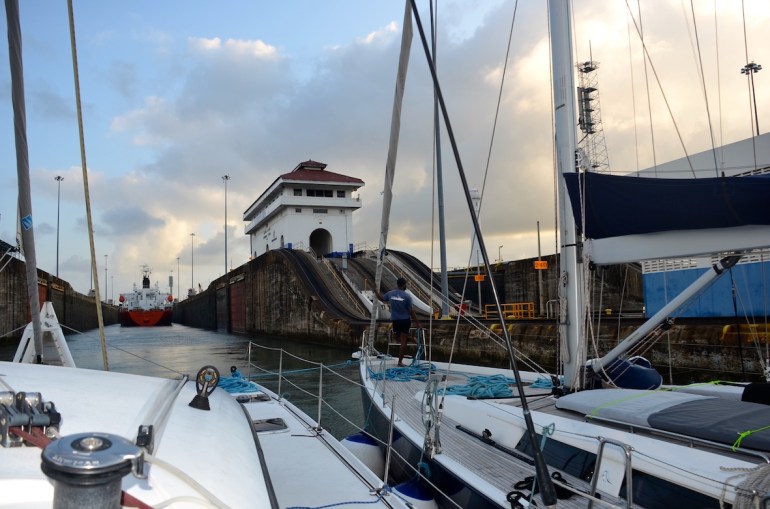
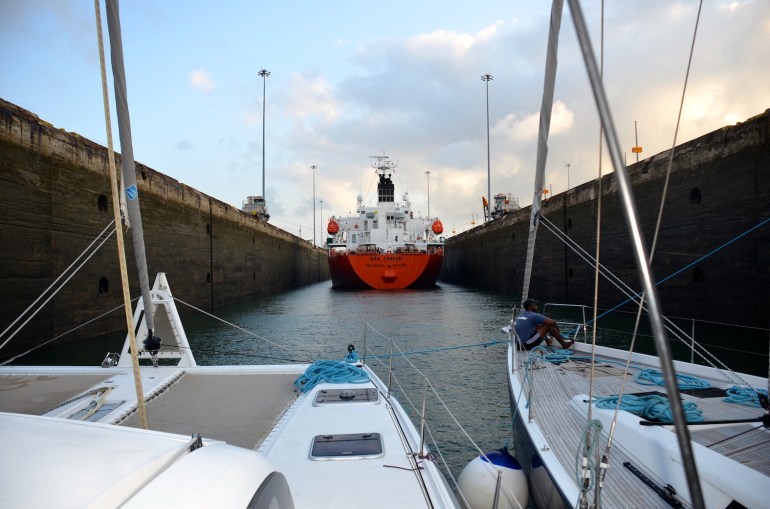
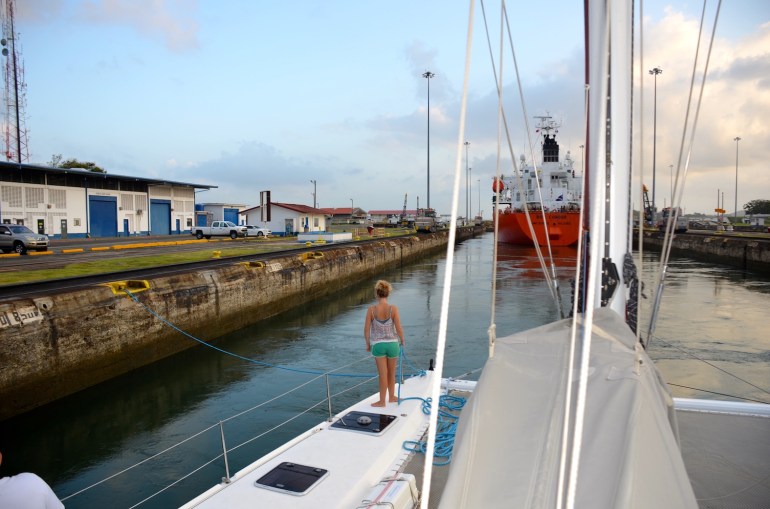
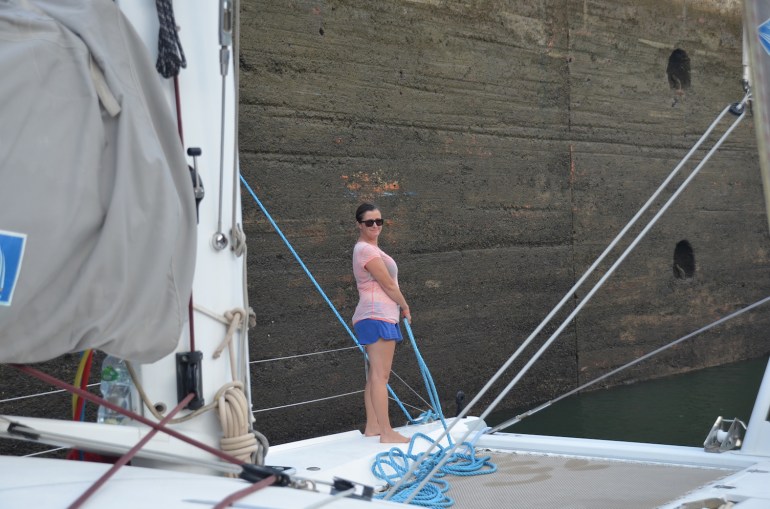
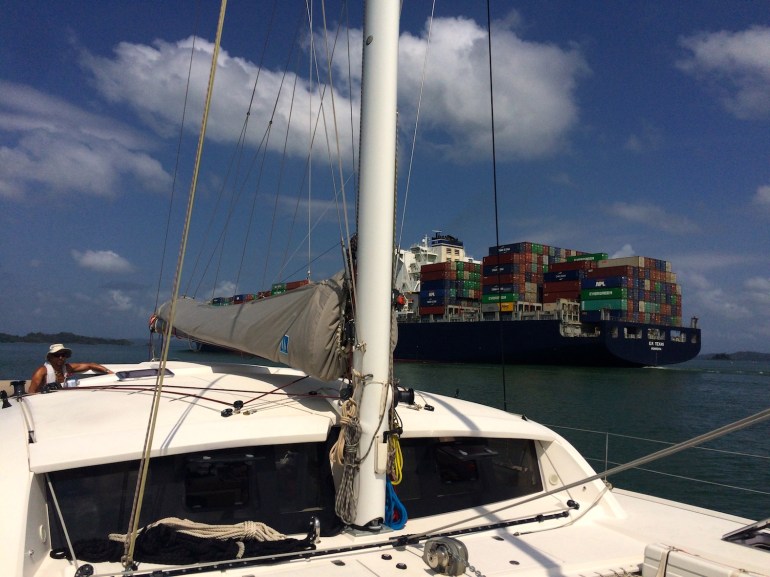
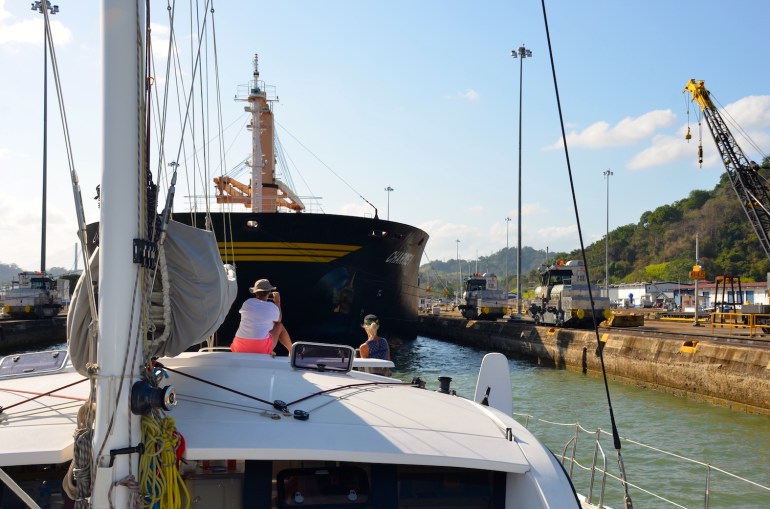
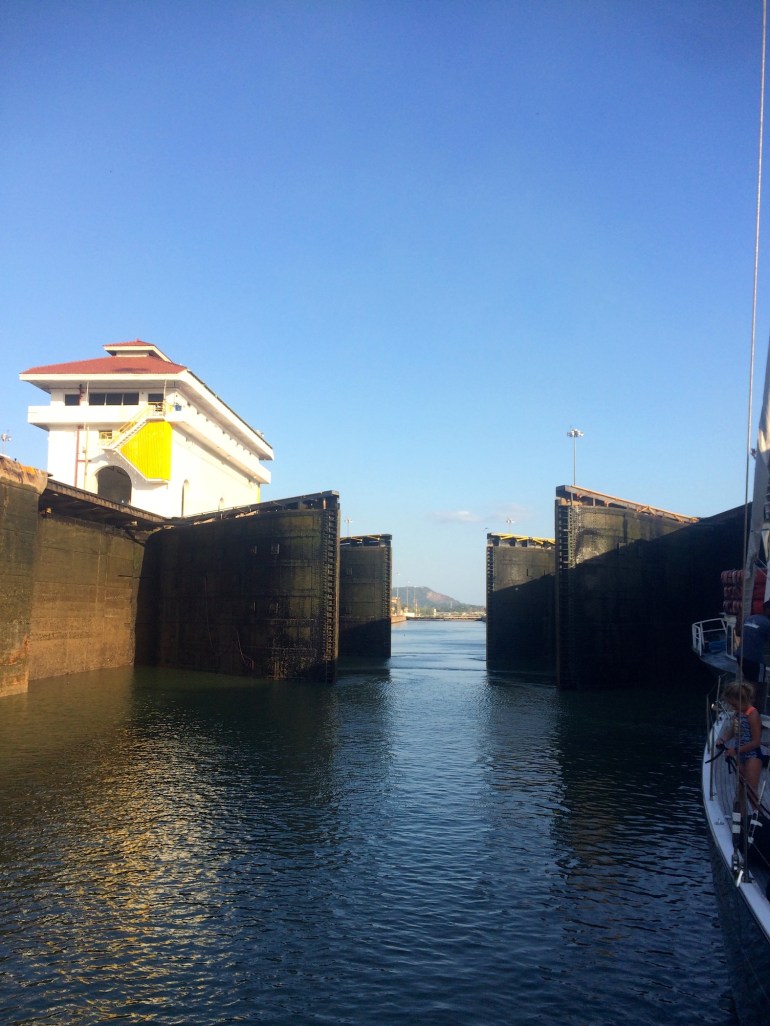
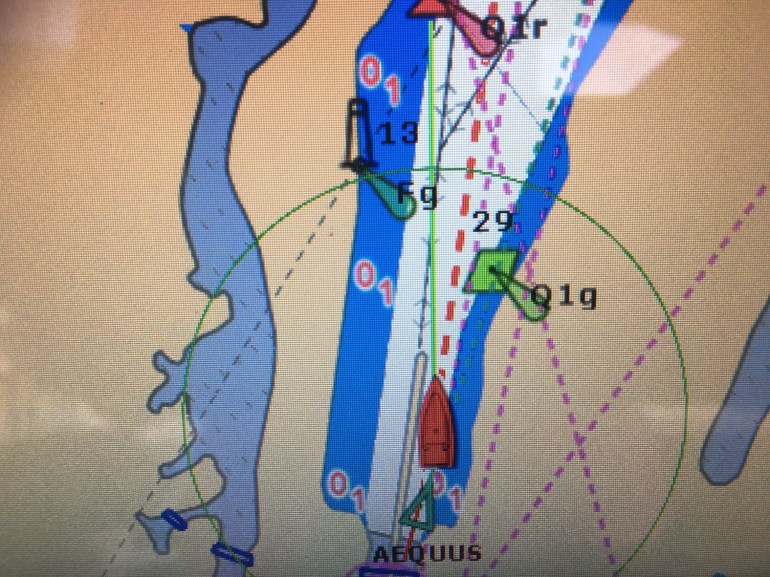
The ship appears and we follow her below the unfinished new bridge to the Gatun locks, rafting up to the yacht Aequus just outside. Her pilot is also called Roy. As we motor slowly in, lines are thrown from the walls on both sides. Light lines with a ‘monkey’s fist’ flying accurately to the four corners of our ‘raft’. We tie them to our heavy nylon lines which are hauled up and secured.

DSC_7377DSC_7382DSC_7386DSC_7384

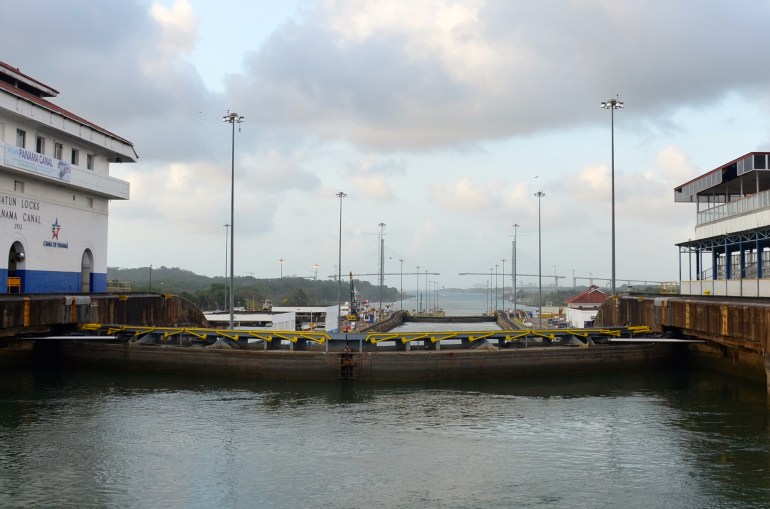
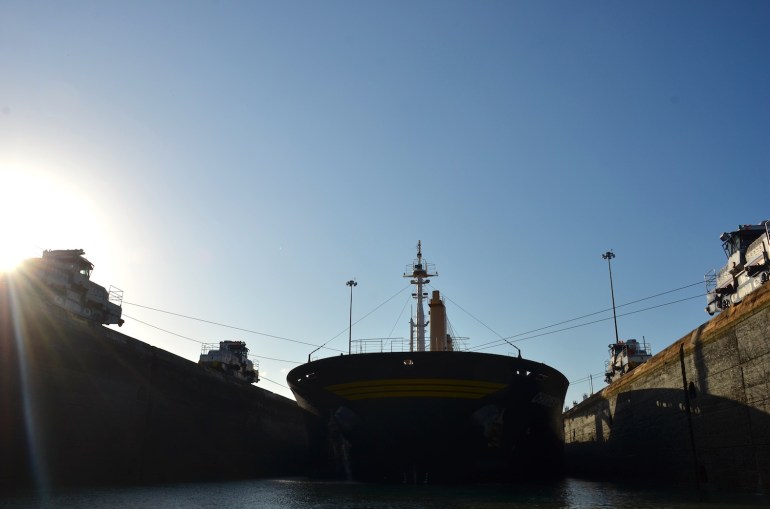
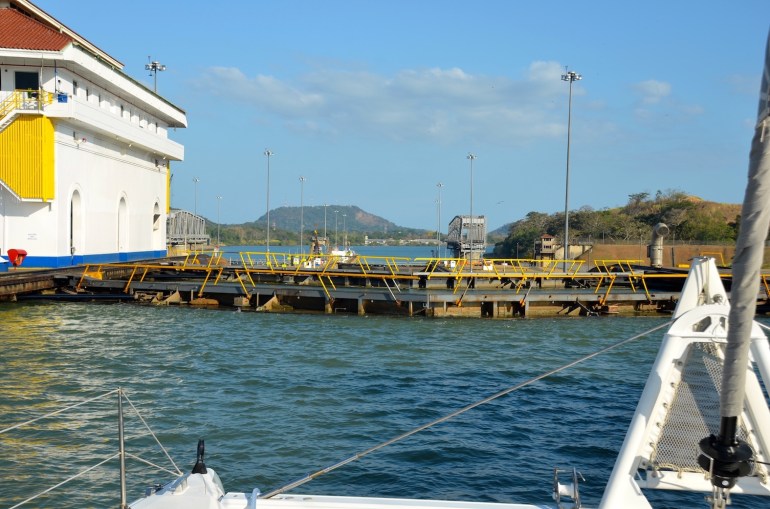
The locks are 980ft long and once the ship was tied up there was room for our little raft in the space behind her. The gates close and 150 million litres of Panamanian rainwater fill the lock, lifting the giant ship and two sailing boats up 9 meters in as many minutes. Turbulent waters as the fresh and salt mix around us. Gates open, we all move forward in to the next two locks and the process is repeated until we have the bizarre view from the top of the third lock, looking back down to the Caribbean, now 27 metres below.

DSC_7387

There are jungly hilltops up here, and a lighthouse! Escapade moves into the strange environment of the Gatun Lake. Our ocean-going boat in fresh water for the first time, 85 feet above sea level.
We tie up to a huge ship’s mooring buoy for the night, a launch arrives to pick-up the Roys, and we settle down for sunset and supper on the lake.

img_2639.jpg

Next morning we wake to a chorus from the howler monkeys and a steamy, windless day.
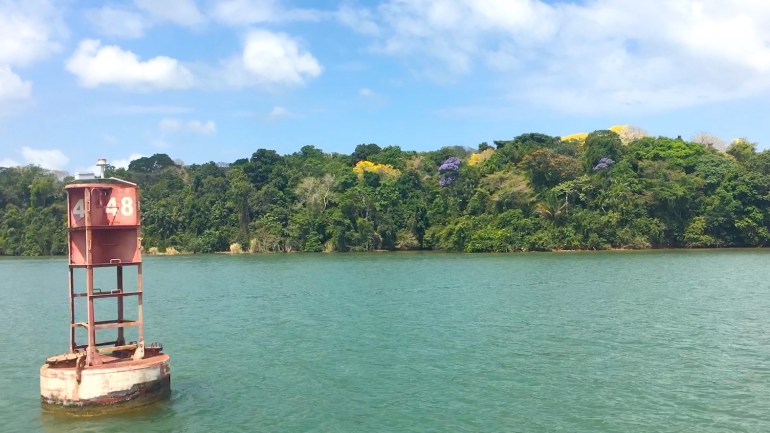
Today’s pilots arrive in time for breakfast; Luis, a trainee advisor and Ricardo, his examiner. Together they will pilot us across the 30 miles of lake to the Miraflores locks. The buoyed channel runs around beautiful islands in the lake, lush rainforest filled with wildlife, a few feet from the world’s freight plying endlessly between oceans.

JungleDSC_7439IMG_2717

Little boats like us don’t tend to get too close to giant bulk carriers and container ships, generally best passed at a distance. But here we are invited in to the big ship’s world. Sharing locks and channels with the largest craft ever built.

IMG_2561 2DSC_7449

For 100 years, ships have been built to the dimensions of the Panama locks, apparently squeezing in with inches to spare. They are hauled through with locomotives towing them on steel hawsers.

DSC_7456DSC_7426

Last year a set of new, wider locks opened for a new generation of even larger ships. ‘Neo Panamax’, the one-way toll for these giants to use the canal is a million dollars.

DSC_7393

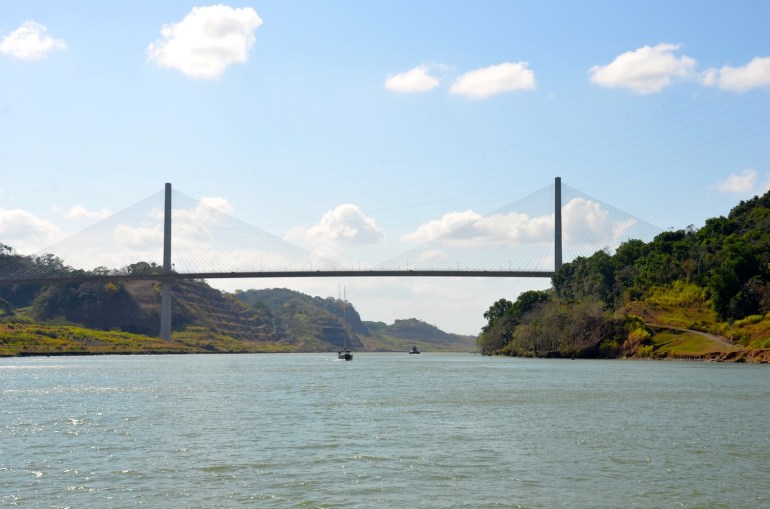
One of these broke down as we were approaching the locks, delaying us for two hours before our final sprint down the Gaillard cut and under the centenary bridge to the Miraflores locks.

DSC_7398

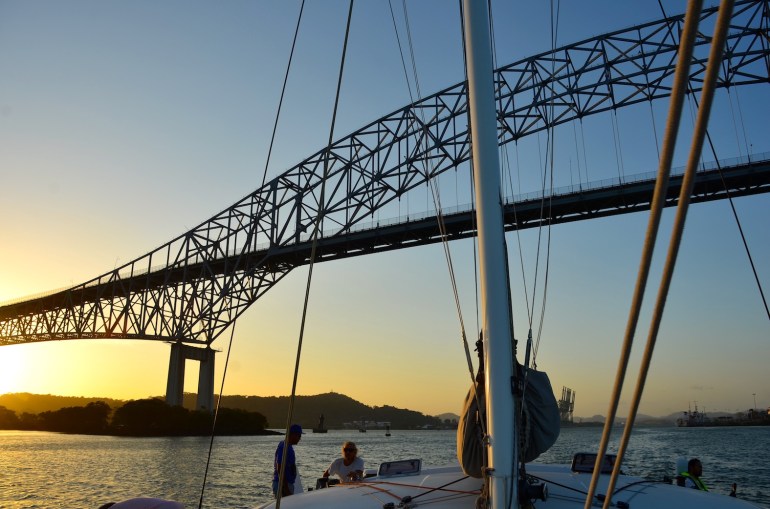
Then down through the Miraflores lake, into the last two locks tied up against a tourist ferry, and finally the last set of gates open and we untie and motor out into the Pacific Ocean. Pelicans diving as we glide under the Bridge of the Americas in the golden sunset. Quite a moment.

DSC_7418DSC_7403

DSC_7435IMG_2581DSC_7463DSC_7481DSC_7490DSC_7505IMG_2773IMG_2797

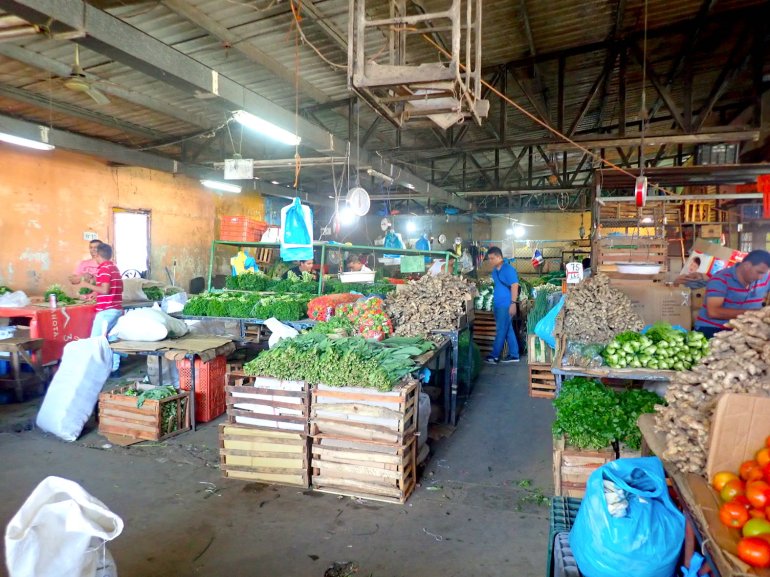
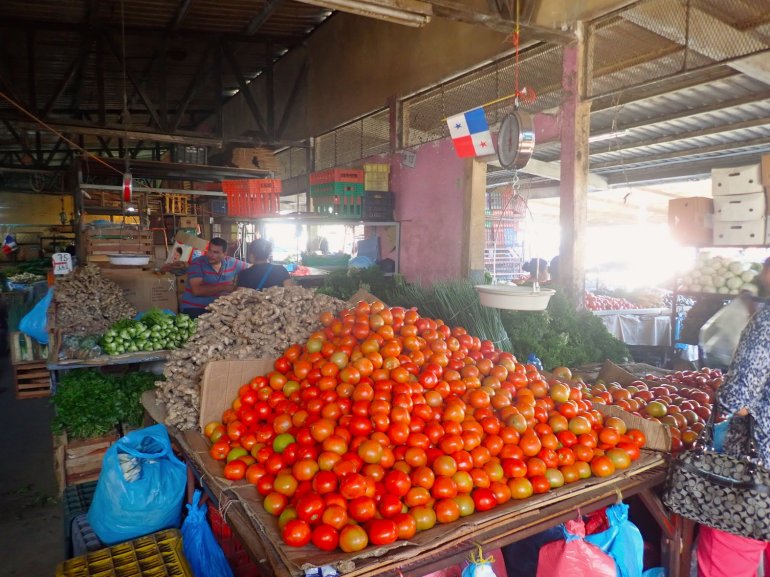
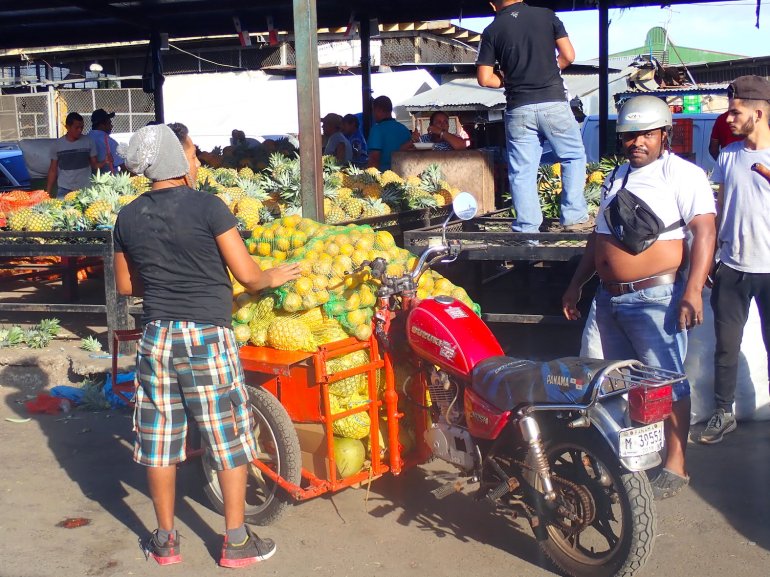
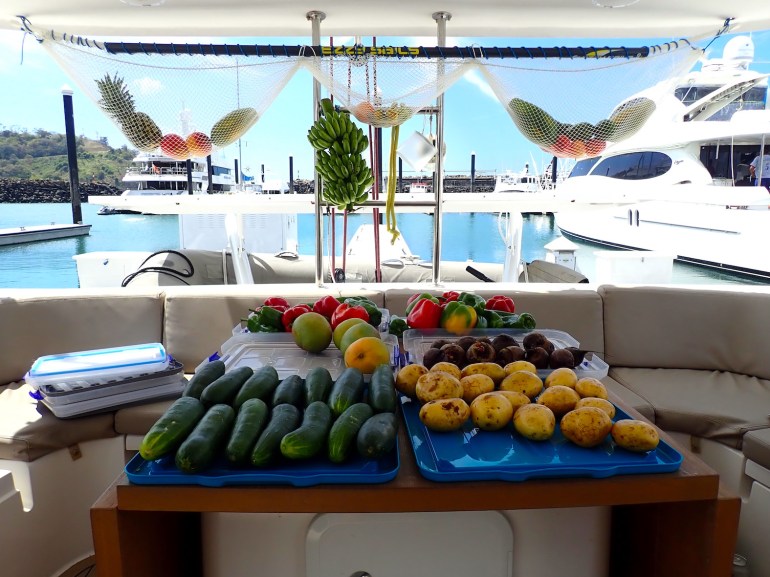
Then a few more days in Panama City, preparing and provisioning. Dawn and Jemima run a highly organised victualling program, filling the boat with food, wine, beer and finally a trip to the Mercado Abasto, the huge clearing house for the fresh fruit and vegetables of Panama.

OLYMPUS DIGITAL CAMERAOLYMPUS DIGITAL CAMERAOLYMPUS DIGITAL CAMERA

It begins at 03.00 every day, farmers arrive with truck loads of farm-fresh, never-been-refrigerated produce, just how we like it. Lots of hard green tomatoes and papayas to slowly ripen on board as we head west. We were there at first light, browsing the huge piles of fresh greens and fruit in the cool of the early morning. As the sun rose higher the aromas of ripe fruit became headier. Our patient porter followed us with his barrow, loaded with our growing haul of goodies. Get that lot stowed, nearly ready to go now…

OLYMPUS DIGITAL CAMERAOLYMPUS DIGITAL CAMERA

Now, where were we?

OLYMPUS DIGITAL CAMERA
First of all, apologies for the long silence on the blog.  The last update was almost a year ago, at the end of our third winter in the Caribbean.
 
Now, where were we?
Oh yes, sailing round the world.
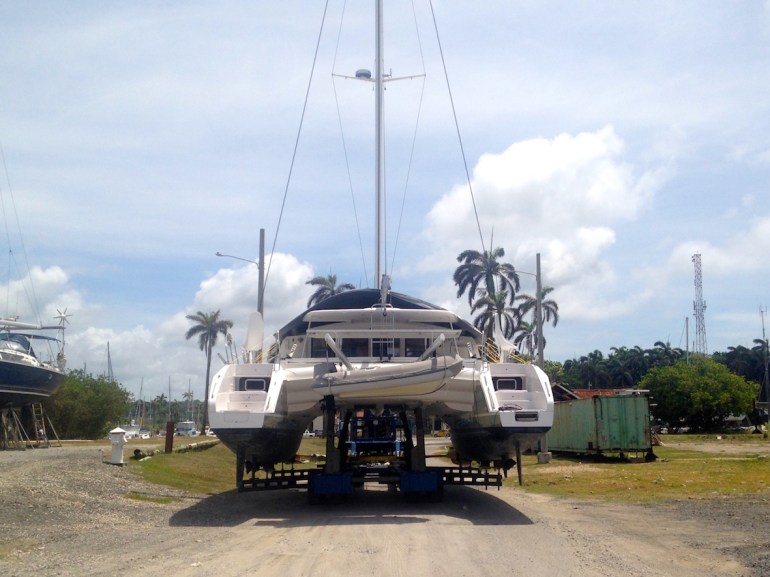
So we lifted Escapade out in April 2017 and left her in a field in Panama while we went home for a while.
Finally we are back on board, that was a longer lay-up than we had planned, but we keep getting distracted..

IMG_2588

A bit of windsurfing:
2017 was a big year of windsurfing for me.
Starting with the magical San Blas islands, the first distraction of the year, then home to Guernsey.
Except that we were on the International Windsurfing Tour which took us to wave competitions in Morocco, Barbados, Mexico, Peru, Chile and Hawaii.
I also managed to fit in the Kona Worlds in Sweden, a longboard race class world championship with a crack squad from Guernsey.
Dawn’s involvement grew into a tour manager role for IWT, so she was increasingly busy while I was competing.
So while the original plan was a summer in Guernsey, the IWT Summer itinerary was too tempting!
A compelling list of destinations and waves to be ridden. So our Guernsey time was shorter than planned, but sweet as always.

Sam & Dawn Barbados

26196417_1558349117536080_2307816838598642435_n

23471944_1939095109440526_4745816541607874866_n.jpg

Maui Time:
After the last event of the tour at Ho’okipa, we stayed on in Maui for a while.  Living on the North Shore and getting plenty of exercise.
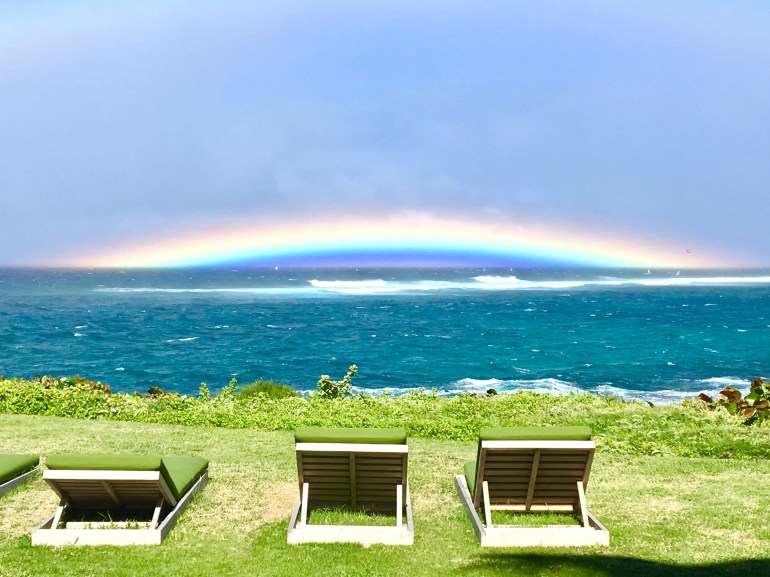
Surfing, windsurfing, wind-foiling (hyrdofoil windsurfing).  Immersed in the healthy, hippie Paia lifestyle; lots of kombucha, chia seeds, hemp protein, yoga, avocados, rainbows and mountainous Hawaiian waves..
It suited us very well and our quick Maui trip extended to three and a half months!

IMG_2559

26231788_1566758876695104_5534456659235036752_n

OLYMPUS DIGITAL CAMERA

Japow!
A quick January pitstop to see family and friends in Guernsey and UK, then off on a snowboard trip to Japan.
More of an expedition really.  I was invited to join friends from Guernsey who are split-board enthusiasts.
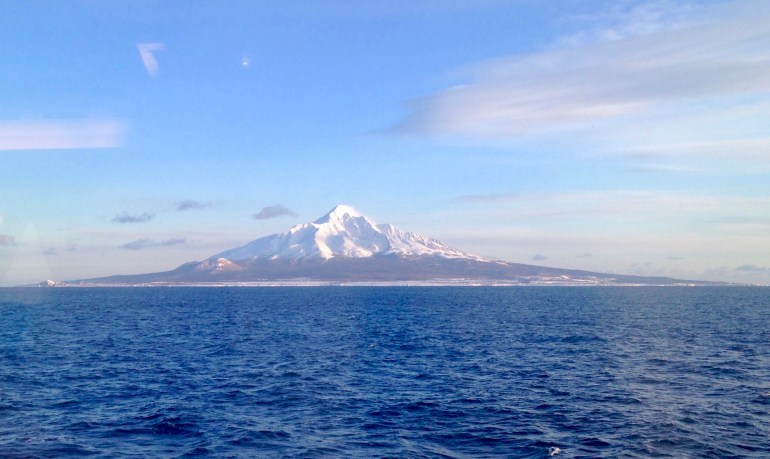
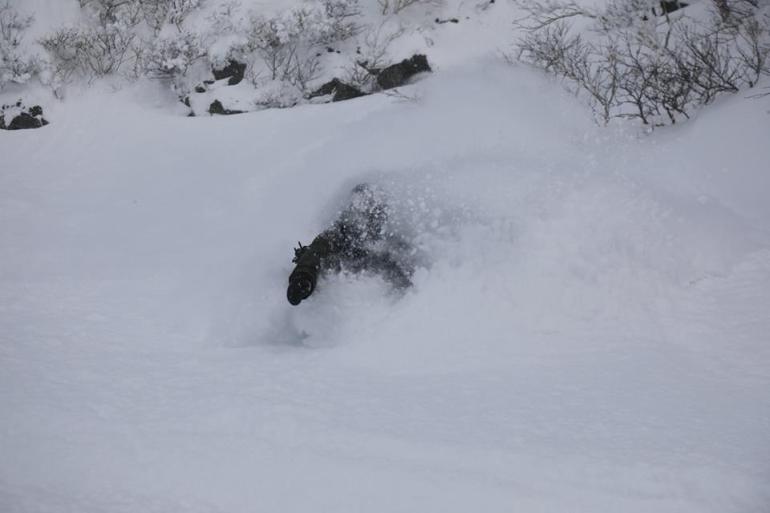
That means that the board splits into two skis, to which you attach climbing skins and crampons, whip out a pair of telescopic ski poles and climb a Japanese mountain, rather than use a ski lift. Sounds like hard work, and it is, but the whole point is that you can go wherever you like, up mountains where there are no lifts, and no skiers.  So we did. Central Hokkaido and then up to the island of Rishiri.  Incredible terrain, fresh Siberian snow every day.  Very cold.  Wonderful toilets.

IMG_277727540790_1199937060139396_4329275349515406163_n

Back to Panama:
So two weeks in the frozen North of Japan, reunited with Dawn in L.A, then straight to the heat of Panama.
Another tropical boatyard; chickens clucking beneath our hulls as we prepare the boat to splash.
Ten months is a long time to leave her in the jungle, long enough for a bit of mould to grow, but we did a really good job of putting her to bed.
Everything was stripped, cleaned and stored.  Sails off, halyards pulled into the mast, all deck gear lines and canvas stowed.  Then a big tarp rigged for sun protection, which was still there when we got back!
It seems so much quicker and more satisfying to be putting it all back together than it was to pack up last year.
The start of a new season and all the adventures to come, pretty good motivation to get her ship shape again.

P2240842.JPG

The to-do list
It seems to me that there is a brief honeymoon period in new-boat ownership.  The first year tends to involve quite a bit of snagging, getting to know all the systems and dealing with the teething problems.  Years 2 and 3 are then blissful seasons of carefree cruising, enjoying life onboard, everything works, with a small and easily ignored ‘to do’ list.
We are now in year 4!
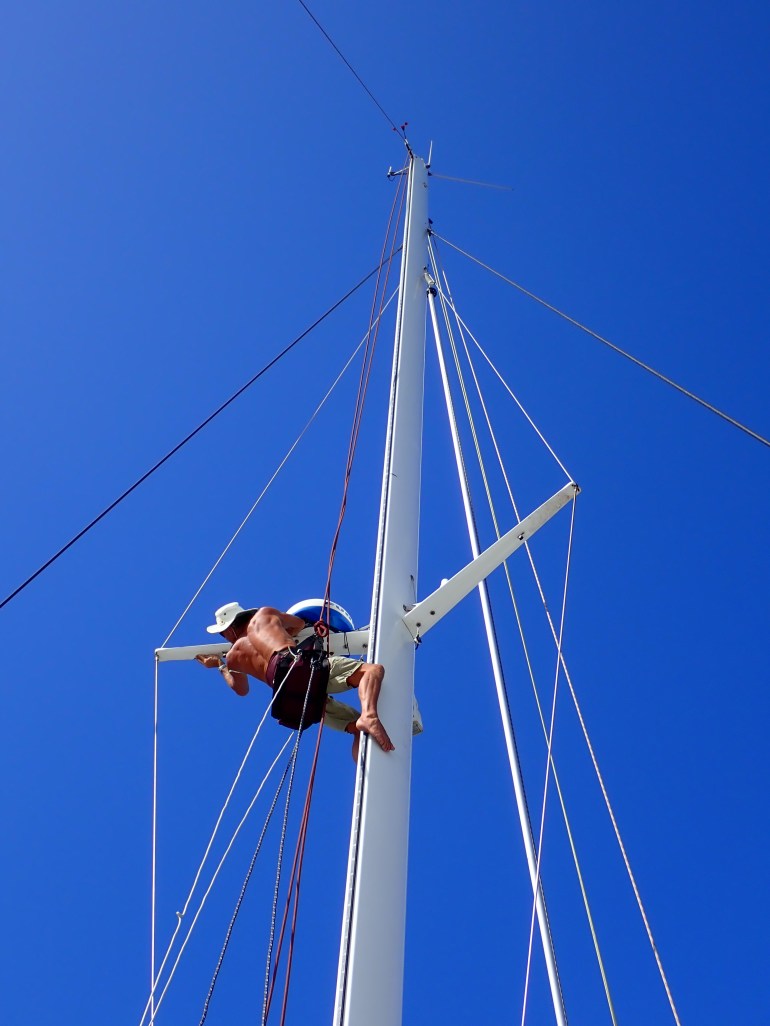
The last few weeks have involved quite a bit of what my daughter Jemima calls ‘Bilge Yoga’. Contorting in to hot, awkward spaces to replace water pumps, solenoids, hose-clips etc, keeping corrosion at bay, maintaining all the little 4 year old components.  Little things that tell me my new-boat honeymoon might be coming to an end.
She is still a young boat, but old enough now to have seen a few gear failures.  We have just had to replace a Facnor roller furler and a Furuno chart plotter display.

IMG_2538.jpg

Hydro-power
We also added a bit of complexity by installing a Hydrogenerator.
We have been so happy with our decision to live by solar power only (no generator).  Our 600W panels provide all the juice we need for life at anchor: pumps, lights, cold beers, charged Macs and even running the water-maker. The last three winters in the Caribbean have been sunshine powered.
The Pacific will be different, long ocean passages with the auto pilot working day and night, depleting the battery bank (No solar at night!).  Escapade powers across oceans with foaming wakes and an abundance of free energy in her sails.  So we have installed a Watt&Sea hydro-generator which should be able to produce clean electricity from all of that wind-driven boat speed.  I will report back on how it performs once we get going.

Jungle Jogging
After all that boat yard work we have been escaping into the Panamanian forest for some exercise. It’s a great nature trail, this week we have seen howler monkeys, white-faced capuchin monkeys, three-toed sloths, parrots, a magnificent toucan and an anteater.

P4140014

Ready for the canal..
We have paid the money, had the boat measured, filled in all the forms. Now we have a date for our transit.
29th March Escapade will travel the 35 miles across the Isthmus from Caribbean to Pacific.  The next chapter!

IMG_2536

A little movie

The cutting room floor

Tidying up the Escapade files we found a few scraps of film from last year plus some recent shots of San Blas.

Dawn stitched it all together for this quick end-of-season roundup featuring Dawn, JP, Jemima and special guest Monkey…

Caribbean: ✓

DJI_0003

The ‘Clearing-off Boat’

For many years while we were working in London and spending weekends on boats in Chichester Harbour, there was a long running discussion about the ‘Clearing-off Boat’
Many happy hours were spent discussing the possible attributes of this hypothetical craft on which we would, one day, clear off.  At that time I was keen on cutter rigs, flush foredecks and bowsprits.
The loudest voice of encouragement was always my daughter Jemima who had already crewed us across Biscay and was keen for me to get on with more ocean crossing adventures.
By the time we eventually ‘cleared off’ on Escapade, Jemima was sailing in New Zealand so missed our first winter. Since then she’s covered a few miles sailing to Polynesia and back. But now we have managed to tempt her out of the Pacific for the first time in years.
Finally at the end of our third season, Jemima has come to see us on Escapade.
So here we are, sitting in a San Blas anchorage, looking at the other boats and discussing the possible attributes of her clearing off boat. (Bowsprits etc..)

OLYMPUS DIGITAL CAMERAOLYMPUS DIGITAL CAMERADSCN3550DSC_7150

OLYMPUS DIGITAL CAMERA

Farewell to Guna Yala 

So one last lap of this beautiful archipelago with our special guest. We spent three months living in Guna territory and they looked after us very well. The Guna indians we met supplied us with all our food, welcomed us into their traditional island villages and even to their sacred ceremonies. They are a smiling, peaceful tribe and seem to be very happy in their world. And happy to have us passing through. It makes it a very relaxed place to live on a boat. The islands are safe, crime-free and care-free.
(There’s always an exception: just before we left a French yachtswoman was attacked by a crocodile. The first time anyone has heard of a human being bitten here. She was snorkelling in a popular anchorage where Jemima and I were swimming a few days earlier. She was badly chewed and lucky to survive. The news was a real shock to the locals and yachties who swim there everyday)

OLYMPUS DIGITAL CAMERAOLYMPUS DIGITAL CAMERA

Pescatarians
Our diet for almost all that time was fish, fruit and vegetables. All either caught by us or supplied by passing ulu dugouts. What’s for dinner? Wait and see what shows up. Lots of snapper, the occasional grouper, bonito, octopus, crab, lobster and conch. We also discovered a new method for extracting conch from it’s shell. Rather than chiseling a hole and severing the tendon as we had learned in the eastern Caribbean, the Guna skilfully chip away at the tip of the spiral shell with a machete, then unscrew the whole thing like a corkscrew, pulling the delicious meat out whole through the top.

OLYMPUS DIGITAL CAMERADSC_7126

We discovered a fish smoker, an old lady with racks of reef fish and lobster smoking over smouldering coconut husks. Delicious.

OLYMPUS DIGITAL CAMERA

Most of my carbohydrate intake was in the form of chilled cerveza until we discovered freshly baked Guna bread rolls. Irresistible. We found a woman baking them in her thatch hut ‘panaderia’ and became regular customers. There was even a recent outbreak of toast and Marmite.

OLYMPUS DIGITAL CAMERA
 
Underwater with my daughter…
Jemima seems to have a natural ability for free diving and is very comfortable underwater. We spent lots of time exploring the reefs and drop-offs. We could dive together pretty well, as long as we didn’t make each other laugh.
She was hoping to be windsurfing and kiting too but the wind went very light. We still had enough waves for a couple more surf sessions before we left.

OLYMPUS DIGITAL CAMERAGOPR5174OLYMPUS DIGITAL CAMERA
OLYMPUS DIGITAL CAMERAOLYMPUS DIGITAL CAMERADSC_7195DSC_7054

More Friendly locals
 
The Gunas keep dogs and sometimes pigs. Vet Jemima swooped in to action cuddling piglets and puppies, feeding them and treating their various cuts and scrapes with iodine.

OLYMPUS DIGITAL CAMERAOLYMPUS DIGITAL CAMERAOLYMPUS DIGITAL CAMERA

Jemima and I were passing Isla Linton in the dinghy when I noticed a small dark figure ambling along the beach. As we drew closer I could see he was about four feet tall and holding his tail high behind him. A monkey.

OLYMPUS DIGITAL CAMERA

We waded ashore to say hello. There were three spider monkeys on the beach. A young one who climbed a tree and stayed there watching. A quite loud and aggressive male who occasionally charged towards us baring his teeth and then lost interest and retreated.

OLYMPUS DIGITAL CAMERA

And a third character who was very friendly and seemed to want to tell me something. It began with a handshake. Then he came to sit next to me and slowly reached out with his prehensile tail and softly grasped my ankle.

IMG_1052

Chattering away at me, he gradually moved closer until, to Jemima’s delight, I was encircled by his arms, legs and tail and my new monkey friend seemed to be set on leaving the island with me. I tried to explain that we had to leave and he would have to let go of me, which didn’t go down well. I finally escaped and we motored off with the distraught monkey reaching out to me in tears!


IMG_1057IMG_1065


Colon: the end of the Caribbean
We had a great couple of days sailing from San Blas to Colon, light winds, blue skies, easy broad reaching under full main and gennaker.  A fitting end to the season’s sailing, and the end of our three long winters plying the Caribbean.

DSC_7138DSC_7202

Colon is the sprawling city and container terminal on this side of the Panama Canal. It loomed out of the hazy horizon along with about 50 anchored ships, all waiting to go through the canal. Quite a change of scene after our deserted coconut islands. The screen of our chart plotter went dark with a mass of AIS signals, more ships than we’ve seen all year.

DSC_7219DSC_7222

We slalomed through them, got VHF clearance to proceed from the port controller and charged in under full sail, through the gap in the huge breakwater protecting the entrance to the canal. Escapade’s final flourish was a 12 knot surf down the last swell in to the flat waters of Colon harbour. It felt like a significant landfall (even though we haven’t come far) but behind us now are the Mediterranean, the Atlantic and the Caribbean. When we leave this harbour it will be through the canal to the Pacific.

IMG_2588

Another boatyard
Can it be yard time again already? We are hauling out in Shelter Bay and leaving Escapade here for the summer. Back in to my boatyard shorts..
Time to clean the boat and put everything away out of the sun. Sails off, halyards pulled, decks cleared. I have always considered boats to be sort of self-cleaning, leave them out in the rain for a rinse off, right? Jemima is much more fastidious, she’s worked on super yachts where everything has to be gleaming. So for the first time, Escapade has had the inside of her cockpit lockers scrubbed!

IMG_2379

The boat is spotless, it was great to have Jemima on board for the lay-up, especially since Dawn had fallen over*, broken her foot and was hobbling round the yard on crutches.

IMG_2592

Well there goes another winter. Escapade is safe in the yard, we’ll be back at the end of the year to prepare for the Canal and the Pacific.
Jemima is continuing her travels with friends through Central America, we are heading home to Guernsey for the summer.

OLYMPUS DIGITAL CAMERADSC_6938DJI_0012DSC_7110P4140014DSC_7118DSC_7081

*No alcohol was involved in this injury.

Newer Posts
Older Posts