Menu Close

escapade sailing

life on the ocean

Los Roques

OLYMPUS DIGITAL CAMERA

Living on a sailing boat in the tropics is all pretty good, an endless trail of islands to visit, all different, and naturally we like some more than others. But even the ones we don’t like so much are still pretty good.

If we were to selfishly list our favourite characteristics in a sailing location it could look like this:

  • Uncrowded anchorages
  • Uncommercialised islands
  • Clear clean water
  • Being able to see your anchor dig in to the white sand below.
  • Good fishing
  • Living reefs to snorkel (sadly getting very rare these days)
  • Steady breeze to blow away the mosquitos
  • No cruise ships
  • No charter boats
  • No light pollution
  • Head-high waves on a reef-break within easy reach of the boat
  • (ideally with a reliable side-off wind direction)
  • No kiters

This is the type of sailing that we dream about if we stay on a ‘developed’ island too long. Somewhere remote, off the beaten track. We love that self-sufficient feeling of a boat loaded with supplies and equipped for weeks of exploration.  Welcome to Los Roques..

El Gran Roque

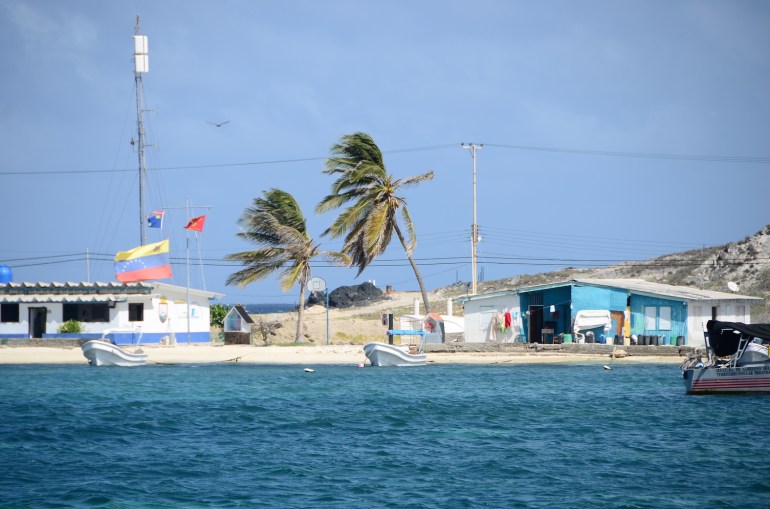
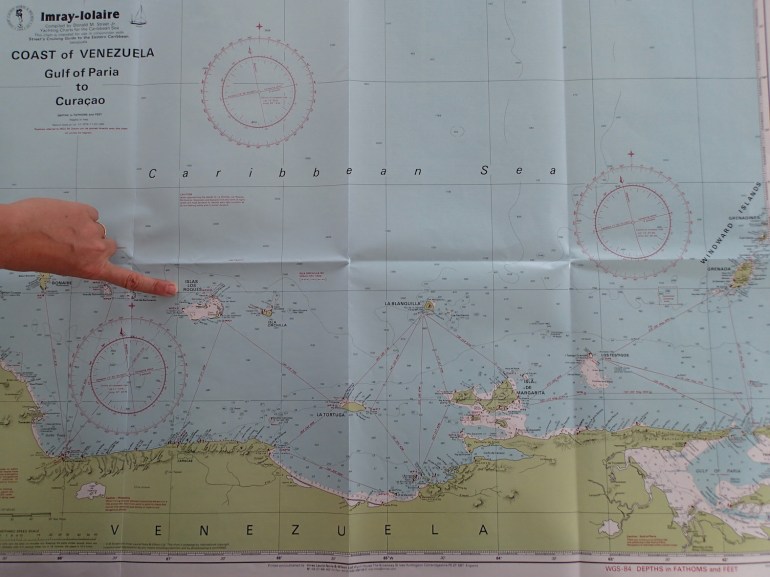
The only real settlement in Los Roques is on the island of El Gran Roque. We arrived at first light. After breakfast and a sleep, we sit anchored off the beach and take in our new surroundings, enjoying the peace of a stationary boat after 400 or so miles at sea. Squawking seabirds and pelicans dive-bombing for fish all around us. No other foreign yachts, lots of skiffs and fishing boats all along the beach, and a small village. These islands are about 80 miles north of mainland Venezuela.

The village on El Gran Roque is a few ‘streets’ of sand and simple painted buildings, the homes of fishing families, posadas and some holiday houses, a little Church on the beach, a school and a few stores.

DSC_1545DSC_1549

Formalities

We started with a tour of the official offices. The first stop was the Guarda Costa who informed us that as we were a foreign registered boat in transit and had not cleared in at any of the official ports of entry to Venezuela, we could only shelter here for three days and not go ashore! A further conversation in broken Spanish and an exchange of some US dollars seemed to improve the mood, we were then led to Immigracion, Parques Nacional, Guarda Nacional, all of whom welcomed us with old fashioned uniformed bureaucracy and painstakingly wrote all of our ship’s details in their ledgers. Plenty of carbon paper and rubber stamps until finally we were issued with a 15 day cruising permit and a flag to hoist up our mast to prove it. During this process we needed to acquire some Venezuelan currency…

 Bolivares

A local exchange transaction was arranged for us in a tiny grocery store where we converted 200 US Dollars to 140,000 Venezuelan Bolivares. So far so good, but inflation has been pretty fierce over the last few years and the Bolivar has really not kept pace. The largest denomination note is 100 Bolivares, with 20’s and 50’s in common circulation and clearly no longer worth the paper they were printed on. In the grocery store the money was being counted into 10,000 Bolivar wads, our bag was filling up and getting very heavy. Our two US $100 bills were turning into a suitcase full of cash. You can’t use a foreign credit card here, so all the money we spent had to be counted out from these wads of notes. Everything is very reasonably priced. A good caiphirina is about $1.50, a great meal in a restaurant for $10, diesel and gasoline are practically free at few cents per litre. Even so, it is normal for a customer to spend a good few minutes counting out the cash to pay for 4 beers. The cash is received with a weary smile by the bartender who then also has to spend his time counting the notes. One night we tried to buy a few fish from a fisherman cleaning his catch. He gave us a big bag full of silver fishes and would not take any payment (probably not worth his time to count the notes!) we thanked him profusely and bought cold drinks for his children.

OLYMPUS DIGITAL CAMERA

Village Life

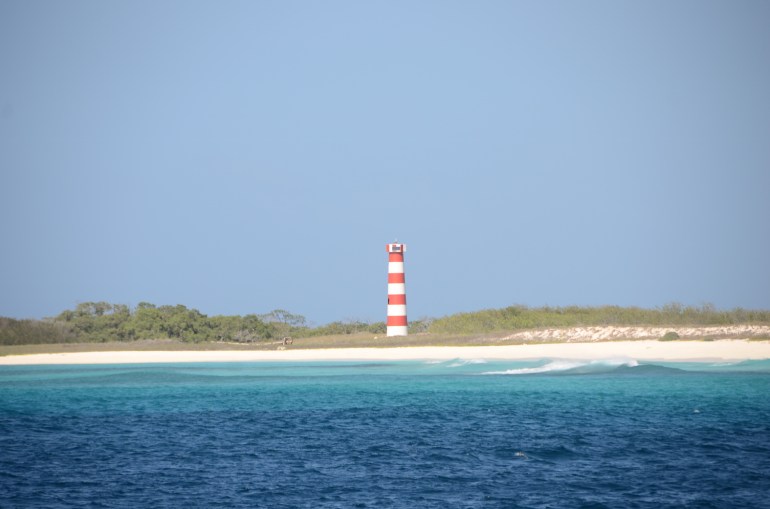
Electricity is now reliable since a new solar array was installed, water is desalinated on the island. There are no cars, no tarmac, and a very pleasant, relaxed pace. Fresh supplies arrive on the weekly ship from the mainland and are transported by hand carts around the village. When not in use these carts were being dragged around as make-believe carnival floats by the children. There are now two motorised trucks on the island, one for water and one for gas. We heard these had managed to have a collision! There are three lighthouses, none of which were working when we arrived. We wandered the sandy lanes, dogs everywhere sleeping in the sun, children playing and making Christmas decorations from plastic bottles and cups. By night the posadas look very inviting as the guests sit down to dinner, but they are for residents only, we find there are just three ‘restaurants’ that would feed us. They are all good, visiting yachts are something of a rarity and we are welcomed with great hospitality and home cooking. Fresh fish and octopus served at simple tables on the sand, and all for just a bag full of Bolivares.

Francisqui

After a day and night in the busy metropolis of El Gran Roque, we sail around the corner to the Francisqui islands and anchor in a breezy lagoon with a mind blowing variety of blue water colours. To windward surf is breaking on a reef. This is starting to look like my windsurfer’s paradise.

DSC_1609DSC_1677

Charlie and Alessandra

We had arranged to meet Charlie and Alessandra in Los Roques, not an easy place to get to, but they travelled from Ibiza via Madrid, Caracas, a 6 seater plane to LR and a local skiff which found us anchored in Francisqui. What a nice surprise! We weren’t expecting them until the next day!

OLYMPUS DIGITAL CAMERA

The Sailing

We lined up outside the carniceria which we heard would have the last shipment of fresh produce before Christmas. We loaded up with fruit and vegetables and sailed away to discover the islands.

Over the next couple of weeks we explored the archipelago under sail. Dozens of low-lying islands, cays, or ‘quis’ around a huge shallow plateau of white sand, mainly uninhabited. The whole plateau covers hundreds of square miles and large areas are designated national parks. We tacked Escapade to windward up narrow blue corridors with live reefs glowing both sides, reached across blues of every shade with someone high up on the cabin roof scanning for coral heads as we slalomed through under sail. Anchored in clear water behind remote cays between reefs, sandbars, and mangroves. We sailed past entrances to deserted lagoons where we imagined dinosaurs could still exist unnoticed.

We sailed over to Crasqui where Juanita and her family cooked a lobster lunch for us on the beach, while we chatted with her talking parrots. Every day and night the trades blew 20kts, we rarely saw another yacht. Just an amazing place to take your boat for a sail.

The Fishing

This place is fishy. Fish jumping all around the boat, fish bouncing off your back as you dinghy ashore at night.

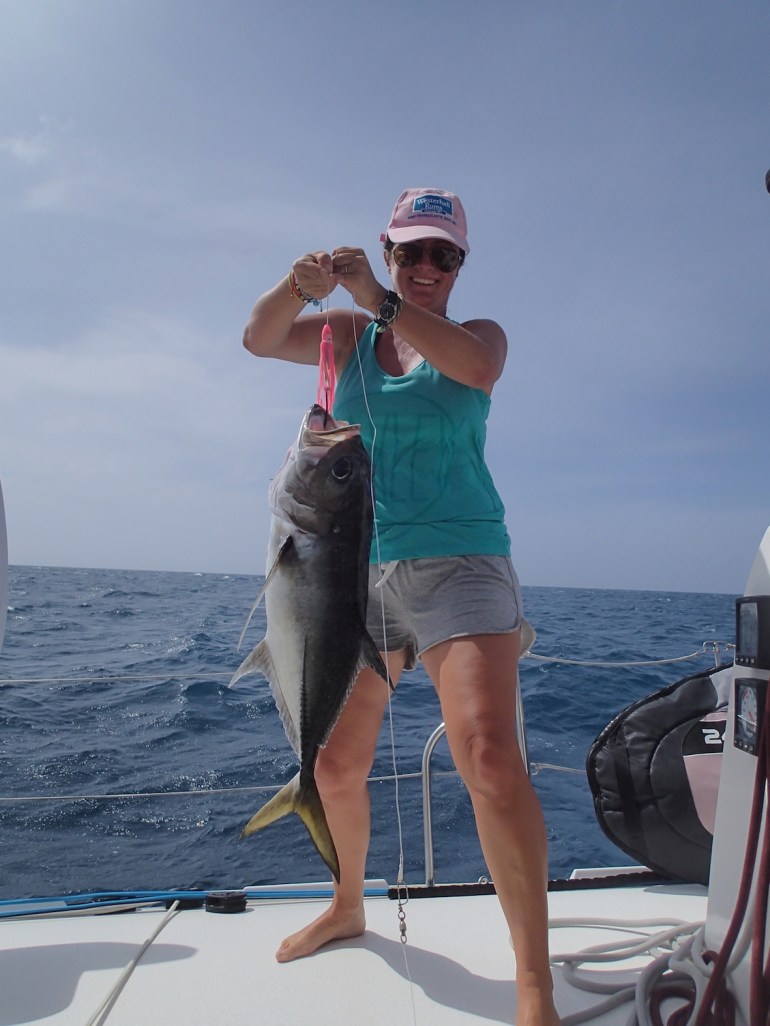
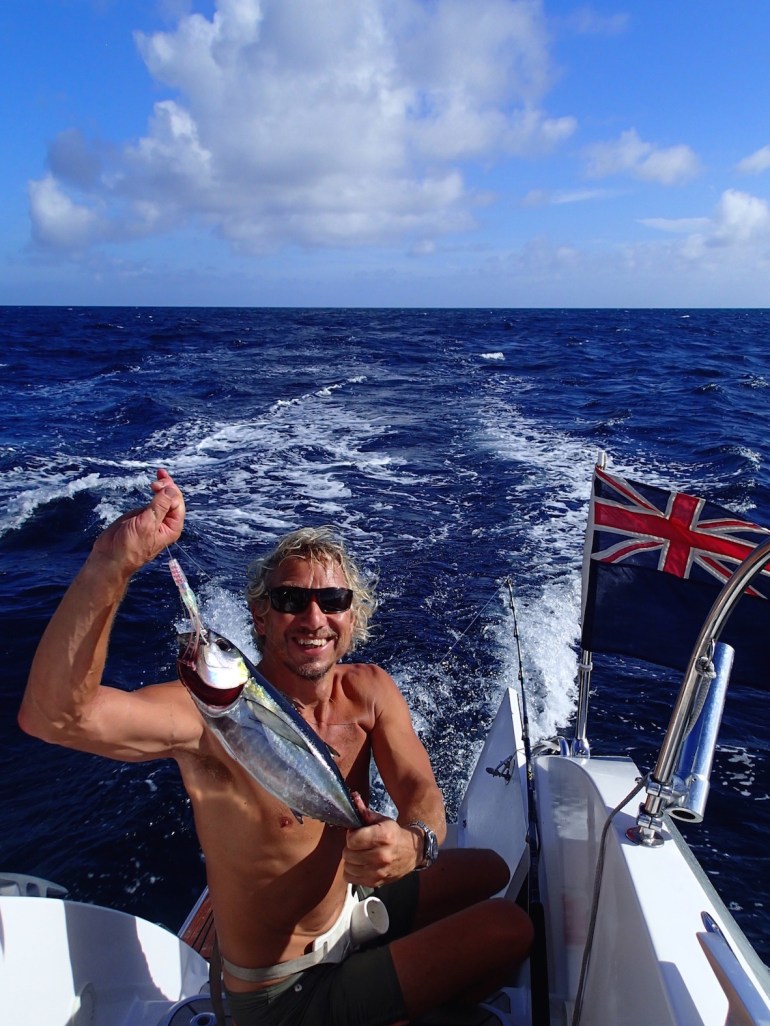
We trolled lures most days and ate so much fresh fish. Bonito, spanish mackerel, snapper, grunts and a few unidentified species.

We also dropped a baited hook off the back of the boat around sundown and even developed a new ‘snorkel assisted’ fishing method. I happened to be snorkelling past Aless’s line on my way back from my nightly anchor check when I noticed several fish taking an interest in the bait, down in the depths of clear water below. I swam over and dangled the hook in front of the largest snapper and he was soon chomping away on the scrap of fresh tuna I had presented to him. Surprised that this had not done the trick, after a while I gave a sharp tug on the line to firmly pull the little hook into the fish, which immediately went wild, swimming off in all directions as Aless wound him in. The whole crew was kept busy scaling, gutting and filleting multiple species.

The galley was turning out sashimi, tartare, ceviche, fried fillets, gougons fried in spiced flour, fish curries, fish spaghettis, fish salads and fish tagines.

We snorkelled reefs teeming with fish and inquisitive barracudas cruising just below the surface. Spearfishing is forbidden.


The Windsurfing (and Kiting)

 Non-Windsurfers – Please feel free to skip to the next section…

When my nephew Charlie was a young lad, I taught him and his sister to windsurf. I delivered windsurf gear out to Ibiza, spent happy summers windsurfing with them at our beach house in England.

They loved it and Charlie showed great promise with a natural talent for windsurfing. We have sailed boards together in Ibiza, Egypt, Morocco, England and the Caribbean, while I nurtured his interest in the sport.

Imagine then the shame, frustration and gut-wrenching despair, when he took up kiting.

Of course he is now a very accomplished kiter and still pretty useful on a windsurfer.

Our stay in Los Roques was to be a pretty special opportunity for us both.

Firstly it was windy. Just enough variation to have a chat about sail size everyday, but generally 20kts. Then there is the water. Sorry to bang on about this but I have never sailed a board over such beautiful colours. The channels are dark blue, sloping sandbanks form a gradient of shades of turquoise, then onto white sandy plateaus covered by barely a fin-depth of clear water, coral that can be sailed over in places, judging depths from shades of orange, brown and yellow. Turtles and stingrays surprised by a speeding board, big fish jumping waist-high next to you, and outside the barrier reefs, big blue breaking waves.

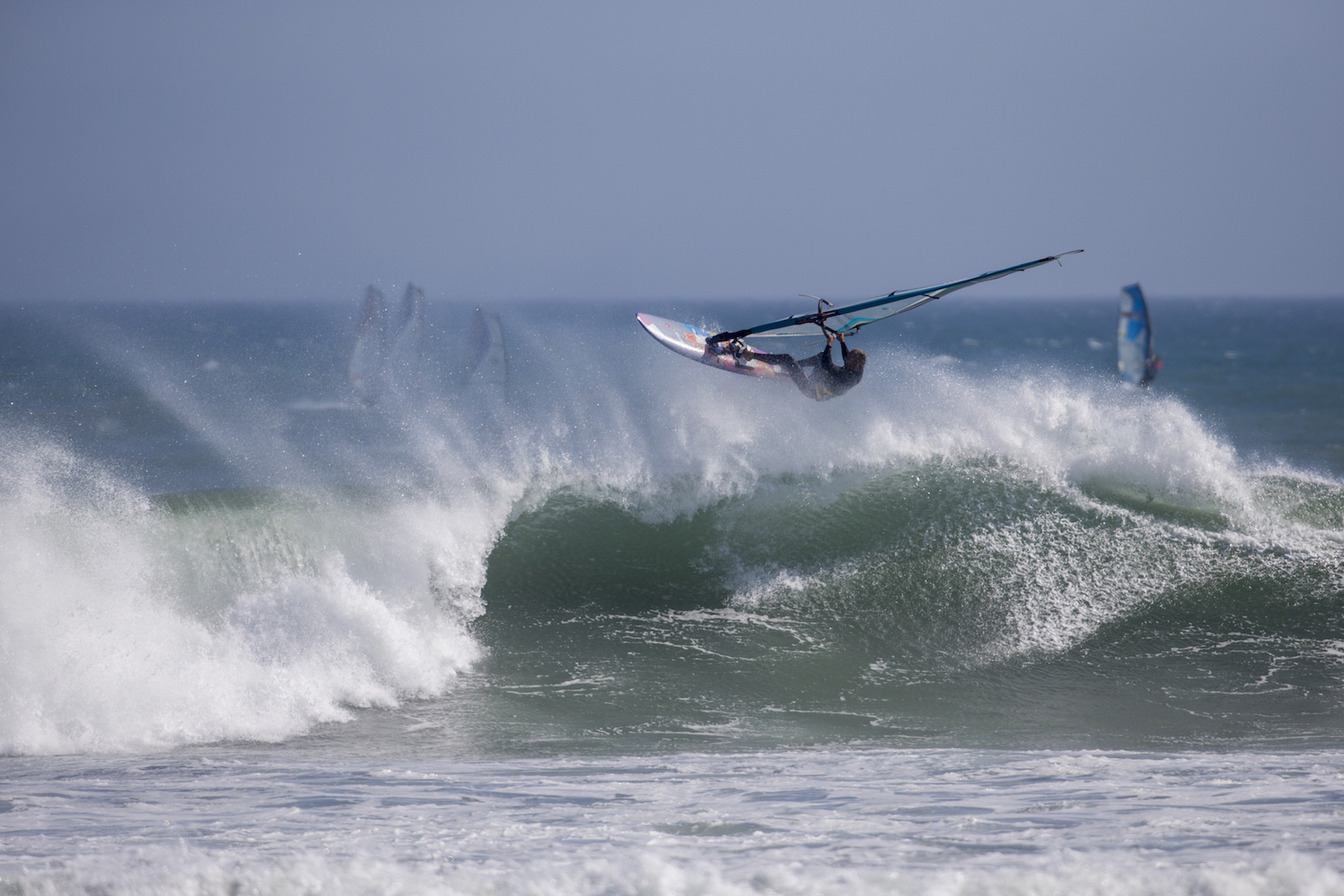
That first day at Francisqui I was exploring a narrow pass in the reef which was tricky but sailable, giving access to some fun jumping and onshore riding. I was soon joined by sail number V111 throwing enormous push loops in front of me. Venezuelan windsurf legend Ricardo Campello had been sailing in the lagoon when he saw me find a way through the reef and followed. He had never sailed that spot before and got a bit carried away with his jumps, snapping his board in half before he remembered he was on his freestyle gear. Ricardo told me the best wave riding was on the leeward side of the island. The next day Charlie and I set out to sail around the island. Out to sea through the keyhole in the reef with a set of transits in case we had to find our way back. Then downwind to the end of the reef where the swells were wrapping round the tip of the island and in to a gusty, offshore point. Could be good for surfing. Further down the leeward coast the swell starts to wall up over a shelf of reef with a solid side-off breeze, the wave wraps in with a couple of peaks and occasionally re-forms all the way to a sandbar on the inside. We had found it, this was to be our playground.

We sailed so many sessions on that reef, Charlie kiting with a surfboard, me on windsurf gear, different generations, different tools for the same job. Generally we were alone, the first couple of days Ricardo was putting on a show, he was living on board his boat and is a regular visitor here, great to sail with him and benefit from his local knowledge before he had to return to Margarita. After that it was just us, sometimes a few surfers, sometimes a couple of windsurfers and kites, Elias and his friends, but mainly we had it to ourselves. Every day we felt a little more dialled-in to the place, dropping in deeper, understanding the reef and the sections, getting better turns. Wave after wave, we had a ball, sailing back round the island to the boat at sunset, exhausted.

The wave is pretty safe once you know where you are, avoid the shallow spots and don’t get caught on the inside. The only real hazard is the long island of razor sharp dry coral right in front of the take off. You wouldn’t want to end up there..

Christmas Day Chaos

On Christmas morning I found 3 limes in the sock I had hung up in the cockpit the night before.

The wind was up as usual and we could see spray above the mangroves indicating that our wave was working again.

Charlie decided to take a windsurf board instead of a kite, for a change.

We set off on a pair of boards and rigs from Escapade’s Quatro/Ezzy/Streamlined quiver and arrived to find we had the reef to ourselves.

Charlie sailed a few waves realising how much more satisfying a real top-turn is, before depositing his gear on the aforementioned reef to be pounded by a set or two.

What was salvaged was a mast, an extension and some harness lines. But hey, nobody got hurt!

Time to Move on

We had one last night ashore in the village and sailed again to explore the Western islands of Los Roques, arriving in Cayo de Agua on the last day of 2015. No other boats in sight, we found our way through the reefs to another turquiose pool to anchor in. It was so beautiful we stayed another day, exploring ashore, scrumping coconuts and windsurfing between islands. We welcomed 2016 from the middle of nowhere, then sailed west again.

DSC_1746DSC_1709

Las Aves

30 miles or so to the West are two tiny archipelagos of Las Aves.

Even more remote, and even more fishy!

A world of diving birds, jumping fish, reefs, dunes and mangroves.

As we finally sailed away across the Sotovento lagoon we had multiple strikes on the lures and landed a couple of fish we have yet to identify. Each lure was in the water for seconds before getting a bite. At one memorable moment Aless was filleting her catch, Charlie was fighting a big fish on one stern while Dawn was hauling in catch of the day on the other.

OLYMPUS DIGITAL CAMERA

Return to Civilisation

We sailed for 6 hours to reach the Dutch island of Bonaire, where Charlie and Aless could get a flight to the next part of their trip. I think we were all a bit reluctant to change gear from our wild world of birds and fish to this other world of cars, bright lights, internet, air-con and international flights. So it was farewell to Charlie and Alessandra, thanks for coming all that way, it was worth it!

Sailing to Los Roques

OLYMPUS DIGITAL CAMERA

Bit of a delayed post, again.  We have been offline for weeks.

So after all that provisioning and preparation, we did not in fact set sail on 13th December, well we did, but not far. As we left the bay that afternoon I engaged the autopilot and found it was not working, with a message I had not seen on the screen before: ‘FAIL’, that doesn’t look good. Not keen on hand-steering 400 miles downwind, we dropped sails and motored into Prickly Bay.  Fearing the worst, Dawn performed the Furuno analytical tests which concluded again with the rather terminal sounding: ‘FAIL’. Hmm, If something is seriously wrong we may need a Furuno technician! Spare parts shipped in!  At Christmas time!  We could be stuck here for weeks! The next morning we were very happy to find a blown 10A fuse.  Simple to replace as long as you’re carrying a spare, which we weren’t.  But of course our friends on Mr Curly were, thanks for the spare part delivery Richard! That was it, pilot fixed, ready to go again. (After a quick trip to Ace Hardware to stock up on spare fuses of all sizes.)

Go West
So we sailed away from Grenada on the afternoon of the 14th December with the autopilot purring quietly to keep us on course. There is often a moment of joy on board Escapade as we sail over the horizon again, out of sight of land and ships. The speed of the boat and the sheer freedom of being out there can lead to spontaneous singing.  And dancing.  Our lure soon attracted a beautiful yellowfin tuna which was fishmongered into fillets for the fridge and ceviche for supper.  We sailed SW at first to avoid the wind shadow in the lee of Grenada, then Northwest again to sail far off the Venezuelan shore. Yachts are very concerned about sailing close to this coast with several recent reports of armed boardings of sailing boats by Venezuelan pirates. As the sun set, the mood on board changed.  We have been sailing on night watches together for many years now, but the first night still takes a bit of getting used to.  After dinner we went up to the trampoline and lay face down watching the green sparks of phosphorescence flash by.  As I stood up I saw a flash and found a couple of stranded flying fish which would be appearing on the breakfast menu in a few hours.

 OLYMPUS DIGITAL CAMERA

Notes from a night watch
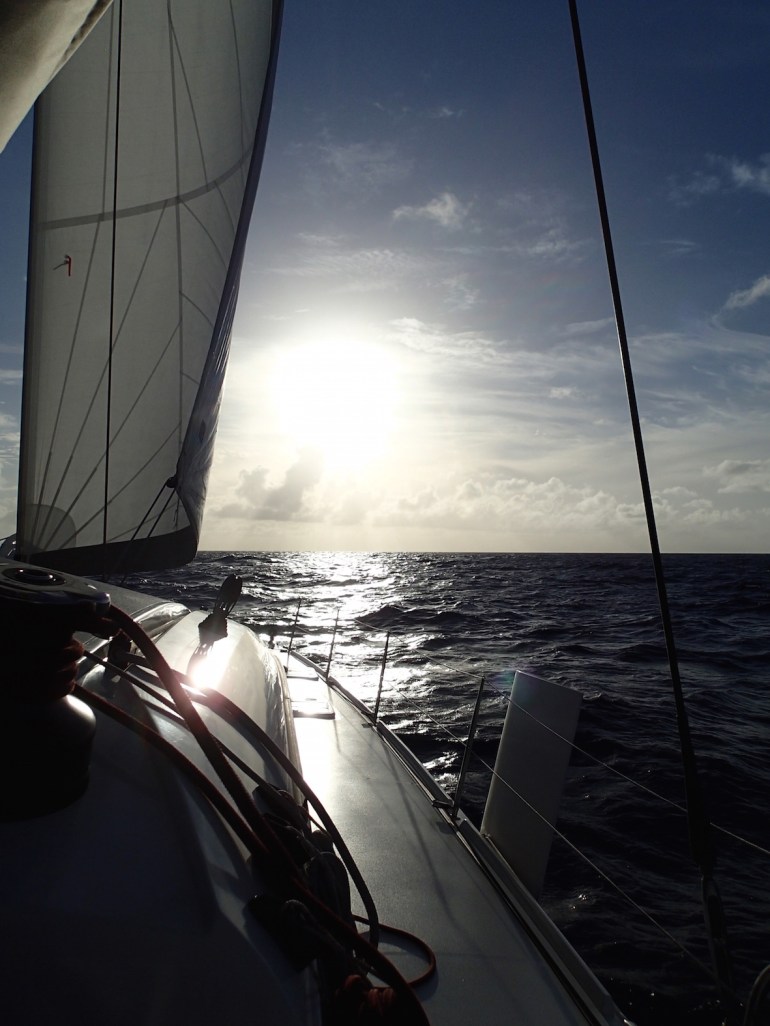
I take the first watch and settle in to the warm tropical night, alone on deck. At 20.30 the sliver of new moon sets in the West and the starry dome is just mesmerising.  A perfect dark sky with no moon or cloud, I turn off the nav lights for a while, to enjoy it all.  The only light pollution is the phosphorescence which is now ridiculously bright with fiery light streaming out behind in our wakes.  I imagine a whale’s eye view of Escapade from below, two green comets streaking across the black surface.  This time last year we had a similar experience on passage from the Canaries to Cape Verde, now we are in new waters, away from the Eastern Caribbean Islands that have become familiar, this is the furthest West we have sailed so far.  I wish on a shooting star which is going our way. For me this is still strong magic, it feels like a view of the world that few people ever experience.  The boat is perfectly trimmed and just eating up the miles, requiring nothing from me. Dawn is asleep and I’m free to enjoy the night and this view of the universe. 
There is a simple, elemental joy out here, sometimes when I go up on deck it feels like we are sailing through space, floating in the blackness.  Actually I am moving across the Earth in my own personal disc of wilderness.  The horizon is maybe 20 miles away so Pi-R-Squared makes that disc about 1200 sq miles of Caribbean Sea with nobody in it except us and a few billion sea creatures.  Some of those want to join me, I am hit in the chest by a flying fish while sitting at the helm, he seems unharmed so I scoop him up and re-launch him.  Below our hulls the sea bed is 2km down and above the sails the galaxies slowly rotate.  The occasional shooting star has now upgraded to a full-scale meteor shower and I have run out of things to wish for.  They are raining down, everything from multiple short white scratches on the dark sky, to great balls of fire leaving long trails.  By now I’m wondering what might have been in my Grenadian coffee.  I have since found out that this was the ‘Geminids’ putting on a show.  (A well known annual astronomical event, with meteorites arriving from the direction of the Gemini constellation.)  There can be no better place to see it.  I think of all the sailors on ships through the ages who must have experienced nights at sea like this, but tonight it’s all mine.  Escapade is flying through the darkness at 10kts, sailing towards the tiny islands of Los Roques, with the constellations turning above me like the hands of a clock.
 
 Daybreak arrival
That was a pretty special night watch for me, but they are not all like that.  Dawn took over at 02.00 and had cloud, rain squalls and container ships to dodge. 
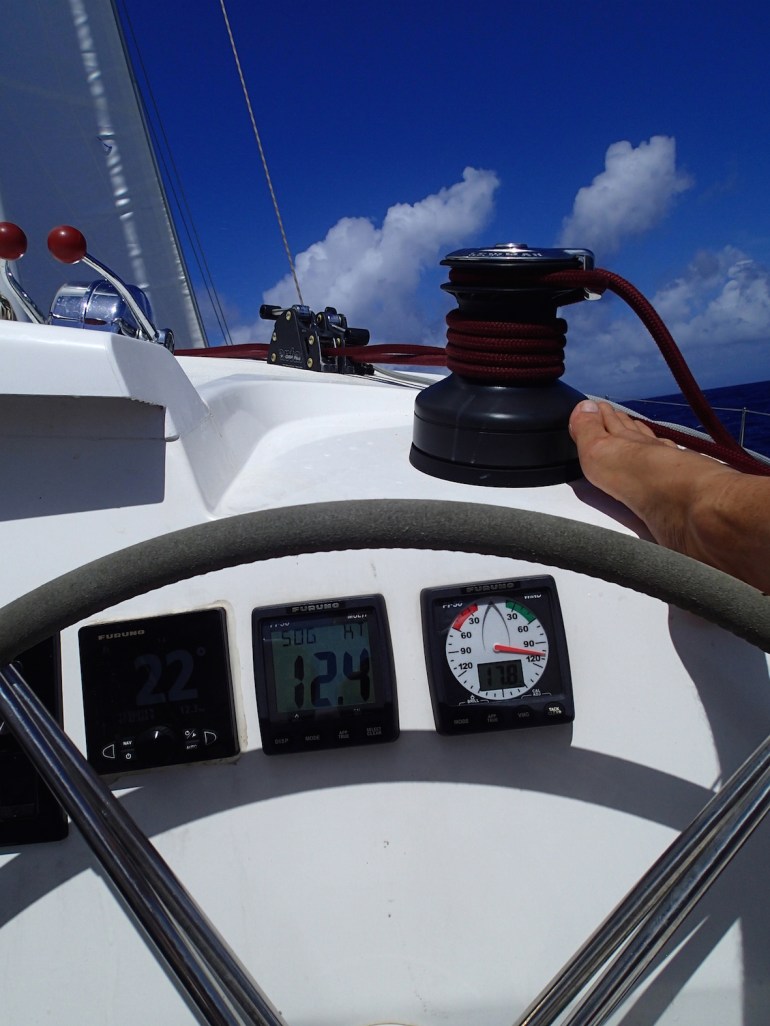
We sailed all through the next day and night, now steering SW again on Port tack and heading straight for Los Roques.  We measure the distance left and try to plan our boat speed for an 8am arrival.  Escapade is cruising at 10-12 kts on a broad reach and surfing at 15+.  Too quick, we don’t want to arrive in the dark.  We pull down the second reef and try to calm her down.  We had a worrying hour or so around suppertime when we were buzzed by an unidentified vessel shining very bright searchlights and seeming to be interested in us.  We have since seen a Venezuelan Guarda Costa ship and think it may have been them, but it’s easy to get a bit jumpy in these waters at night.  After a fresh tuna supper I have a snooze and we settle in to our second night at sea.  I wake up to find we are surfing at 15kts again, too fast for a daylight landfall.  I spent the rest of the night trying to slow the boat down.  Dawn had assured me that first light was at 05.15 so anytime after that would be fine to approach the islands.  By 0400 we have 2 reefs, I have rolled up the jib and the boat is still sailing at 10kts+!   I have also decorated the cabin with our Spanish paper garlands from last year as today is Dawn’s birthday.  At 05.15 we are both on deck and bearing down on Los Roques fast.  It is still very dark.  Then we realise there is a time difference.  We have sailed so far West we have changed time zones! (This is also the first half-hour time zone I can remember adjusting my watch to, a bit strange, but the first of many strange new experiences in Venezuela)  It is just light enough to see as the loom of the village lights silhouette the hilly little island of El Gran Roque, we round up off the beach and drop the hook in a different world.

Stay tuned for the full Los Roques story coming soon while we still have wifi!!

OLYMPUS DIGITAL CAMERA

Grenada Shakedown

OLYMPUS DIGITAL CAMERAAs you sail away from the Bocas Del Dragon,the Northern part of Trinidad causes a huge wind shadow. we motored until we found a few knots of breeze as the sun came up. Jib out, motors off and Escapade was sailing at 8 kts on a smooth sea. As the wind and seas built we were cruising at 10 knots and finding our sea legs again. We were both a bit wobbly that first day, it took a few hours to re-adjust to the motion and remember all the things that soon become second nature again, like the finer points of our reefing procedure.
By mid morning we were passing the huge natural gas drilling platforms and speeding over the sea as it turned from the gravy-dark waters of Trinidad to the true blue of the Caribbean. The final approach to Grenada is interesting as the sea bed rises from a depth of 900m to 30m. The swells pile up over this shelf and the last few miles were a bit of a sleigh ride as we bore away and surfed in to our destination at 15 knots, rolling up the jib and rounding up behind Calvigny Island to drop the main and motor over to our favourite anchorage in the Calvigny Cut. The anchor went down in to white sand at 2pm on the 23rd November and it’s still there as I write this, 2 weeks later.
Escapade pulling gently at her bridle in flat water with a constant breeze, that feels so good after the heat of the yard in Trinidad.
Our view is the coconut fringed beach of Calvigny, we can pick up wifi from the nearby Le Phare Bleu marina.
From here I can tack upwind on my windsurf board and play on the reef-breaks by Adam Island. In my shorts. In December.
We also have easy access to all the fun and facilities of Grenada. Provisioning in the markets, eating and drinking in the local rum shops and restaurants, plus some good live music, liming at the legendary Hog Island Sunday bbq, the finish of the RORC Transatlantic Race, and lots of socialising with friends old and new. Two weeks have passed very agreeably, we have adjusted back to boat-life and now it’s time to move on. We have cleared customs and this afternoon we will set sail for Los Roques, 300nm to our West.
Several people I have spoken to here are not sure where Los Roques is, so in a bid to add some cutting-edge navigational technology to this blog, I have embedded an interactive map which should help:
OLYMPUS DIGITAL CAMERA

Trinidad Splashdown

OLYMPUS DIGITAL CAMERA
Time for an Escapade update!
By end of November the Atlantic hurricane season is over and a new Caribbean sailing season has begun.
We left the cool wind and waves of Guernsey and travelled via London and New York to Trinidad.
Escapade was waiting for us at Peakes Yard in Chaguaramas, just as we had left her. We spent 5 days getting ready for sea again.
It took that long to acclimatise to the steamy heat and recover from a few hectic days and nights in NYC.
Sails on, hulls anti-fouled, all the rigging and deck gear back in place, engines prepared, outboard serviced and back on the dinghy.
We had carefully removed everything possible from summer UV damage, pulled halyards and reefing lines, fitted hatch covers and a huge plastic canopy aft of the mast. Her first lay-up was a great success and she emerged from hibernation good as new. Thanks to Peakes, Dynamite Marine and all the guys who helped to look after us.
We splashed on 22nd November and motored around to the picturesque Scotland Cove. (Looks like Scotland). So good to be afloat again, all the systems came back to life and we spent a quiet evening making sure everything was ready to sail. Next morning we motored out of the cove under the stars, hoisted the main and set a course for Grenada.

Sailing Spindrift 2

Last week I found myself at the helm of a multihull sailing yacht off the South coast of Brittany.

The sun was shining and the instruments told me breeze was blowing at about 14kts.
Our boat speed was 26kts across flat water.
I felt the gust hit the main and the boat started to heel. The gentle hum in the rig became slightly louder and higher in pitch as the breeze hit 17kts and boat speed climbed through 30kts. We hit 33kts with the rig whistling and the spray flying, my hands gripping the rubber covered wheel and my body adjusting to the angle of heel as the windward hull rose high above the sea. The skipper was at my shoulder, speaking with his crew. He leaned towards me and calmly suggested I should bear away a few degrees. There was a loud groaning of the traveller easing under the immense load of the 500 sqm mainsail.
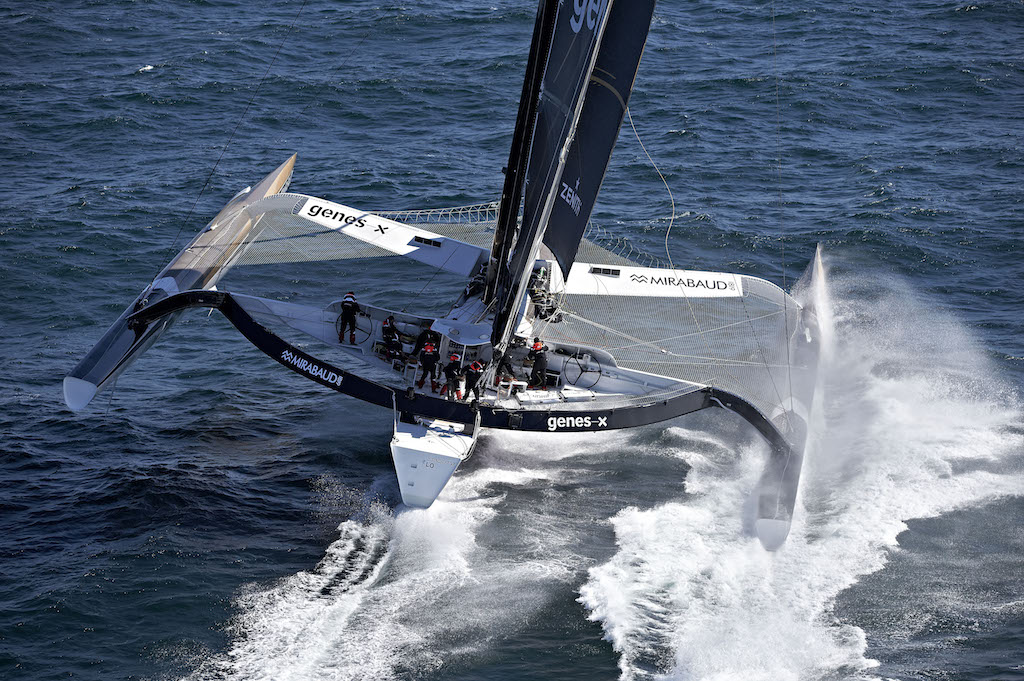
The skipper was Yann Guichard and the yacht was Spindrift 2.

©Th.Martinez/Sea&Co. BELLE ILE - BRITANNY- FRANCE . Maxi

She is the largest, fastest racing trimaran in the world. (Previously Banque Populaire V)
With team Spindrift she is now in an all-out assault on all the major ocean speed records.
They already hold the West-East Atlantic crossing record from New York to Lizard Point in 3 days 15hrs, averaging 33 kts all the way!
Yann and the crew are about to go into a holding period for an attempt at the Jules Verne Trophy for fastest crewed circumnavigation.

 LhRu2J_GDrrhEcL4avbQLQyOEcv2VTJt91vqjeYk4pU

Yann was telling me about his recent trip on Spindrift 2 in the Route du Rhum.
Spindrift 2 usually sails ocean races with a crew of 12-14. The boat is so gigantic and the sheet loads so great, there are miles of spectra lines and huge carbon winch drums. We watched the entire crew grinding at the carbon pedestals for each tack, gybe and sail-change. For the RdR Yann made a few modifications, installed a carbon bicycle behind the main pedestals so that he could grind winches with his leg muscles. He then raced the boat from St Malo to Guadeloupe single-handed!

 b264d154318747e5bf3cc5c7da7ac4c3

The boat is enormous and the sensation of sailing at that speed is hard to describe. As she accelerates on a reach it feels like riding a 747 down a runway, a huge, unstoppable force. The hulls are so long that the chop is smoothed and she seems to be cutting through the water driven by some unseen power. Her speed is out of all proportion to the true wind. Sitting down on the leeward (downhill) hull, it feels like a very wet and windy ride. She can create a gale of apparent wind behind the main sail as the windward hull rises above you and the central hull starts to lift above the surface. All this in 16kts of true wind speed. You look around and see cruising yachts going past as though they are sailing on a different day, almost stationary in comparison.

There are so many mind blowing statistics for this boat, here’s just a few.
For comparison the numbers are shown alongside another high performance multihull:

Compare Escapade Spindrift 2
Length 15m 40m
Beam 7.25m 23m
Hulls 2 3
Weight 10,000kgs 21,500kgs
Max. Sail Area 180 sq.m. 965 sq.m
Cruising Speed 10 knots 30 knots
Maximum Recorded Speed 23.8 knots 49 knots
Max. Recorded Distance in 24 Hours 242 miles 907 miles. Average speed 37.8 knots…. AVERAGE!!
Optimum Crew for Ocean Sailing 2 14 Pros
Very few ‘civilians’ get to ride on this machine and we considered it a great privilege. We were in Trinité as guests of Zenith Watches and Team Spindrift. They looked after us very well indeed. The gastronomic experience was a far cry from the dehydrated spacefood the crew usually eat.
Four of us from Guernsey were lucky enough to be invited and even more lucky to have a private aircraft to get us there and back.
Many thanks to Dave for putting it all together and making it happen. And also to and Andy for providing the plane. And flying it.
An extraordinary yacht, a very cool plane, an unforgettable trip.

JP

Mexican Wave

_G7V4014

A quick update for our sailing friends. No we’re not off course. Escapade is still in Trinidad while Dawn and I have some time ashore.
So far that has been in Miami, Ibiza, Guernsey, London, California, and this trip to San Carlos in Mexico..

Everything you need and nothing you don’t
Punta San Carlos is a remote point break around 300 miles South of Tijuana on the Pacific coast of Baja, Mexico.
The landscape is rugged desert between mountains and ocean. The nearest tarmac road is 50 miles away.
In this unlikely spot Kevin Trejo has established a remarkable surf camp in the wilderness.
This was our second trip down there and I’m sure we will be back.
I like to ride waves on a windsurf board and this place offers some of the best and most consistent conditions for this that I have found anywhere. (And I have searched.)
We have spent a total of 3 weeks there and I could have surfed and windsurfed every day. (I did need to rest my shoulder for a day!)
There are several surf spots and a local thermally enhanced wind effect which is perfectly angled for wave sailing.
The place is magic. There are no crowds (of humans) but the ocean is popping with life: seals, sea lions, dolphins, whales. And the squadrons of majestic pelicans flying in formation with wingtips on the wave-face.
Life is simple at the Solosports camp: glassy surf in the mornings, windsurf in the afternoons, eat great homemade food from Emerita’s camp kitchen, drink a few Baja Fogs* and sleep soundly in a tent by the ocean.
There are racks of surfboards, paddleboards, kite and windsurf gear, (including exactly the same boards and rigs I have on Escapade) as well as great mountain bikes and miles of trails through spectacular terrain. Dawn and I enjoyed hiking and biking the surrounding area.
The desert is rough and rocky, but the whole camp area is carpeted! Barefoot ‘luxury’ to your tent and ideal for oceanfront yoga and stretching sessions after all that exercise.
I also came to appreciate all the things the camp does not have. No phone connection, no wifi, no light pollution.
In the same way that our most memorable sailing trips are to wild and remote places, San Carlos is a detox from civilisation. The joy of simplicity.
Returning to the crowds and commerce of a US city after 2 weeks in the desert was a shock.

Pritchard Windsurfing Clinic
I have made a couple of discoveries rather late in my windsurfing career, the first was how my sailing could be improved with some coaching.
Last August we had a great week in camp sailing with pro coaches Matt Pritchard and Kevin McGillivray. My first ‘lesson’ after 35 years of self-taught windsurfing!
These guys watch you, record your riding on video, analyse the playback and explain the fine details of how to do it better.
I was so impressed we returned for more this year. Matt couldn’t make it, so we had to make do with his brother Kevin Pritchard instead. (Matt and Kevin are both multiple world champions.)
We were blessed with a solid swell and wind every day for the training week. Windsurfers from US, Hawaii, Canada, Europe, Australia and Scandinavia had made the trip. A great group to sail and camp with and all the water time we could handle.
Our patient coaches KMac and KP pushed me to improve my riding, turn tighter and hit the lip of a wave in the right spot to land an aerial back on the wave face, rather than crashing behind it.
After a full day on the water, the group would gather in comfy chairs on the cliff to drink a cold beer and watch the ‘Golden Hour’. The last hour of sunlight with wind and waves still firing. The last guys out were generally KP, KMac and local prodigy Joey Sanchez. Throwing themselves in to huge turns and aerials on the biggest set waves right in front of the camp, all to loud cheering from the assembled audience. What a show.
The following week was when the American Windsurf Tour were holding their annual contest in San Carlos so we stayed on for that.
Second discovery: I enjoyed competing in my first ever wave contest! New kid on the block, aged 50.

AWT Desert Showdown
The contest week was a whole new game, with more riders arriving from around the world and plenty of talent on the water.
The AWT team arrived and the point became a competition site with a judging panel stationed on the cliff above the waves.
Riders are judged on their wave-riding skills, like a surfing contest. Typically a heat will see 4 riders sail for 20 minutes. The judges will score every wave, with each rider’s two best scores to count.
So great to see the pros sailing their heats with such style and power. I could watch them all day. The standout performances were from Boujmaa Guilloul (Morocco) and eventual winner of the Pro division Kevin Pritchard from Maui.
Another sailer from Maui made a big impression. Jake Schettewi won both the youth and amateur divisions, winning a place in the pro division.
He is 14 years old and already sailing with plenty of style.

Full results are here:

Now I have said before on this blog that I’m really not a competitive person. I’m generally happy just to be sailing in good conditions.
But.. when you’re out there in a heat, gybing on to a set wave and riding it in front of the judges and the crowd on the cliff, it is all rather exciting!
I progressed through the heats in two divisions, Amateurs and Masters.
I made it as far as the Amateur semi-finals and was defeated by much better (and younger) sailers. Very pleased with a 5th place.
In the Masters division I had great fun sailing with my own generation and came second! Those aerials came in handy.
The heats were run over a few days and I was also invited to sit with the judging panel and score a few heats. Not an easy task and requiring intense concentration, especially when three riders take off on waves simultaneously!

Throughout all of this Dawn was very busy with photography and physical therapy to keep us injured competitors on the water.

Many thanks to all at Solosports for looking after us, PritchardWindsurfing.com for the great coaching, all our new friends from the clinic and the contest.
Thanks to all at AWT for producing a great event. What a trip. We had a great time and we hope to see you all again soon.

Many thanks also to the photographers who shot the following images:

Clark Merritt at www.Solosports.net
Mark Harpur at www.Luckybeanz.com

*Baja Fog is a bottle of cerveza topped up with tequila and ‘fogged’ with lime juice.

High & Dry

IMG_2270

The last few days in Grenada were busy socialising with our new sailing neighbours from Switzerland and Guernsey, windsurfing at Adam Island and running with the local Hash House Harriers.
This was our first HHH experience. They run at ankle-breaking speed across rocks and tree roots, through jungles, rivers and mountains, following a trail of paper route markers along the way, there are several ‘false trails’ which lead you up dead ends so you have to retrace your steps to the real track, adding considerable mileage! A wild, semi-organised mass run followed by cold beer, various HHH rituals, local street food, loud music and dancing. Seems to be more about partying than running (their T-shirts say ‘Drinkers with a running problem’) but what a great way to experience the rural interior of the island and see the locals having lots of fun.

We enjoyed Grenada, but it was time to get that hook up again. We snuck out of Prickly Bay in the moonlight at 3am and sailed South with 2 reefs in the main on a fast reach for Trinidad.
We passed between oil and gas platforms and the spectacular mountains of Trinidad appeared on the horizon. A large pod of dolphins arrived to welcome us as we approached the islands of the Bocas De Dragon which separate Trinidad from Venezuela. We pass through the Boca in to the Gulf of Paria. Just around the corner is the harbour of Chaguaramas, Escapade’s home for the summer.

Chaguaramas is a busy commercial  port, we anchored amongst cargo ships and support vessels for the oil fields. It is also a favourite spot for weekend party boats loaded with amazing sound systems. Trinidad is loud! It is also hot. But we are here because it is a great place to leave the boat for the hurricane season. The shore is lined with yards full of yachts doing the same thing.
Escapade was hauled out for the first time since we launched her last July. Then began a long, hot week working on the boat. A few running repairs, preparing her for storage, maintaining engines, watermaker, outboard, removing sails and anything else that can be stowed out of the sun. Did I mention that it was hot? After 6 months in the tropics we thought we were acclimatised, but this is no breezy anchorage! When the sun beats down on the boatyard the temperatures soar. Hot work. I’m sure many readers of this blog will be very happy to hear that we sweated through a long week of hard graft! We drank gallons of coconut water trying to stay hydrated. Finally we reached the end of the list of chores. Escapade is cleaned from stem to stern and is sitting safely ashore until we return in November.
We even washed the salty bag of courtesy flags hoisted in all the countries visited so far.

As we cleared out Dawn was asked to leave the customs office and return only when ‘appropriately attired’.

We were keen to see beyond the boat-town of Chaguaramas and we have time to explore a little in Port of Spain (loud!), eating amazing food from the melting pot of Trinidad cuisine. Caribbean, Indian and Chinese flavours, great street food and a big city feel we haven’t had for a while. Trinidad is much bigger than the other Caribbean islands we’ve seen lately, with a more diverse racial mix, more industry, commerce and louder music!

So that’s the end of Escapade’s first sailing season. Thousands of miles, dozens of islands, so many good times and lots of new friends.
We are on our way back to Guernsey (scenic route via Miami and Ibiza).

We have already booked the travel-hoist to re launch 27th November. That gives us a few months to make our sailing plans for next winter.
But you know how we are with plans.

Precious Time

The Grenadines
This winter has been our first extended sailing trip. Our free time used to be measured in days, weekends and occasional holidays, but always with a fixed return date to get back to work. Nine months on board seems to be long enough to get over all that! Time changes in the islands. It’s too hot to rush. People live slowly and everything runs on Caribbean Flexitime. (Similar to the Mañana arrangement, but with more rum.) Time becomes liquid and flows past the boat. The sun sets, the moon rises, the days pass and we swing at anchor, watching the world turn.
Our plans go with the flow. We sailed from Martinique to the Grenadines, arrived in Bequia for a day, but stayed for a week.
Next stop was Mustique for a night, but we stayed for three. Down through Canouan for their regatta, Mayreau for a couple of days, over to the Tobago Cays to swim with the Turtles and windsurf the beautiful Horseshoe reef. Days slip by. South to Union Island and Carriacou, then a fast sail down to Grenada.
Grenada
We explored some of the bays in the South of the island, then found a nice anchorage with everything we like: a constant cool breeze, great views, flat water, wifi from a nearby marina and good surf on the reef just upwind. We dropped the anchor here for a night. I think that was a week ago, still here. We have been exploring inland, hiking in the jungle, swimming in waterfalls, eating our way through our tuna catch, falling off the back of the boat to cool off, eating our way through the endless ripe mango season, windsurfing fun waves on the reef, and touring the surrounding bays and islands by dinghy. But now time is finally catching up with us on this trip and we can hear the clock ticking again.
For the first time in months we have a deadline. Hurricane season is here and we have arranged for Escapade to be hauled out in Trinidad 11th July. She will be stored there for the summer while we return to Guernsey. Our last passage for this season will be about 90 miles down to Chaguaramas in Trinidad next week. We will pack up the toys, leave the boat and try to be rehabilitated back in to the real world.
For a while..

Southbound with Monty. Part 2

IMG_4626
Barbuda:
I managed to get completely lost on my early morning run around the wilds of Barbuda, few landmarks in the sandy tracks through the scrub. Nobody around to ask except the wild deer, donkeys and land crabs I met on the way. The sun was getting too high by the time I found my way back to the boat, very hot and in need of a dip before we raised the anchor and navigated through the reef pass and out to sea. Sails up and two fishing lines out. Soon we have a good size Spanish mackerel* on one line, while wrapping the other around a rudder. This was to be the last fish Monty and I landed on his trip, although we continued to troll a lure most of the time. There is a huge amount of Sargasso sea weed in the ocean this year. It is a free-floating weed that grows on the surface and moves with wind and current. we have encountered massive rafts of it, but more usually it seems organised in long strips aligned to the wind direction. We saw it all the way across the Atlantic and around the Caribbean. It is heavy enough to clog the fins of my windsurf board so that I have to stop and remove it. And of course it is disastrous for fishing. The lures don’t look so enticing to fish when festooned with a grass skirt of sargasso weed. Later in the day we sailed through a big floating island of this weed which slowed the boat from 10kts to 3kts and miraculously dragged the fouled fishing line free from the rudder!
 *May have been a kingfish?

Antigua:
We enjoyed a great sail down the W coast of Antigua and Monty took the helm as we short-tacked up the Goat’s Head Channel, eyeballing the coral on each side before the final approach to Falmouth Harbour. As we dropped the sails and looked for a spot to anchor we could hear a major party on Pigeon Beach. It was the lay-day in the regatta week and the crews were being entertained.
We head ashore for some wifi and get the update from Team New Zealand. All’s well. We pass by Dawn’s favourite restaurants as Monty wants to have a ‘rootsy’ Antiguan experience. So we start with a beer at the IMPROVE Rasta Shack. It’s Sailing Week so there is street food, music and impromptu bars everywhere. All the race crews seemed to be having an early night but we had a late one with the locals who were all out to enjoy the evening. Charlene’s steam fish washed down with cold Wadadli.
Next morning we sailed out of Falmouth and past the leeward mark of the first race of the day. The fleet came streaking past, including the spectacular foiling G4 Gunboat.
Escapade is headed South again, the volcano on Montserrat is smoking moodily to starboard and the green mountains of Guadeloupe are rising ahead.

Guadeloupe:
We spent the night in the fishing village of Deshais where we cleared customs, ate good French pizza on the beach and sampled an authentic ‘Ti Punch’.
Next day we continued South down the coast of Guadeloupe, past the Cousteau marine reserve and on to the group of small islands ‘Les Saintes’ a few miles S of Guadeloupe. We enjoyed these isles with their goats and guanas, we spent a few days exploring some remote anchorages, windsurfing, snorkelling and eating well in the charming village at Bourg des Saintes.
Then it’s time to go, and the next island twenty miles to the South is Dominica. Twenty miles, but a world away.

Dominica:
It was very windy as we rounded the bluff and sailed in towards the town of Portsmouth in Prince Rupert Bay. A local guy in a small boat came to greet us and direct us to his mooring. He had motored a couple of miles offshore in 30 kts of wind to be the first ‘boat boy’ to contact us and thus enjoy exclusive trading rights with us according to the local code of practice. This starts with him renting us a mooring. It is not the most secure looking arrangement but as Titus takes our lines he assures us the mooring is sound. We have seen gusts of 35kts and there are whitecaps all over the bay. Titus comes aboard for a beer and he is a mine of local information. He would like to arrange jungle hikes and river trips for us. Whatever we need, Titus is our man. There is a brief misunderstanding at the mention of the word ‘weed’. We were referring to the Sargasso, Titus to the local mountain variety.
The moment we stepped ashore we felt at home here. It’s hard to explain the appeal of this island. The funniest, friendliest people who welcomed us into their life and culture. Wild misty mountains covered in jungle. Neither Monty or I were particularly excited about Dominica from what we had read, but now we would both say it would be the first place that we would return to. Monty even has his own bar here.
The next day it was still blowing hard and I was windsurfing around the bay fully powered on my smallest gear when I saw something that I’m sure I will always remember. As I came speeding back towards our mooring, there was Monty standing on the bow of Escapade. She was underway, serenely gliding through the anchorage and across the bay towards a rocky headland. Monty was less serene, aware that he was now single-handing a 51ft boat adrift in a Force 8, dragging the remains of Titus’s mooring down the port side, while the skipper was doing 25kts on a wave board. They were making pretty good speed under bare poles, but I could catch them.
A challenging moment! Monty threw me a line and I scrambled aboard, we ditched the shredded mooring so we could start engines. From past experience I know that towing a windsurfer behind a yacht can easily compound problems so we manhandled board and rig into the shelter of the cockpit and calmly motored back through the howling wind to drop our anchor off the beach. On 50 meters of chain. Having dived to check the anchor was secure, we ran through a few of the ‘what if?s’. It could have happened at any time in the night! I can’t believe I trusted that mooring and I won’t be doing that again. Monty has a few grey hairs but apart from that no damage done.
Aside from that drama the few days we spent in Dominica were a real pleasure. It is another one of those lands that time forgot. We sailed up the coast and anchored in the wilds, chopping green coconuts and diving for conch (we have at last figured out the correct way to get the meat out of the shell!). Our last night was in the capital Roseau where we were invited to a local reggae party in the boatyard. Now that was a rootsy night!
Next morning at first light we said farewell to the enchanted island of Dominica. Thanks to all our new friends for making us so welcome.

Martinique:
A lively morning sail down to Martinique. Fort De France looms like a big city so we anchor in a quiet bay, but Martinique feels like Europe and is such a contrast to Dominica. Our bubble is burst.
We are here for a crew change. Monty is jumping ship after three weeks, but first Dawn is flying in to join us, so we clean the boat.
So good to have Dawn back on board! She is ready for a swim round the boat after a 38hr trip from Auckland. Mission accomplished and Jemima is healing well.
For three weeks Monty and I have been testing the sanity of our decisions with the ‘Dawn Check’ (If she was on board, would she let me do this?) Now we have the real thing back to keep us out of trouble.
We spend a couple of days swapping stories and eating French Creole food, then it’s time for Monty to go.
Thanks for everything Mont, it was great to sail with you again.
Newer Posts
Older Posts